
Marketing


Mykyta Hryhorenko
CEO & Co-founder
The Question Behind the Hype
AI image tools went from party trick to everywhere in about eighteen months. Midjourney, DALL·E, Firefly. Type a sentence, get a polished product shot or a glossy lifestyle scene in seconds — no photographer, no studio, no shoot day blocked out three weeks ahead. If you spend money on ads, you can see the pull: endless creative, almost no cost, instant turnaround.
Here's the catch nobody likes to say out loud. "Can AI make an image" and "does that image sell anything" are not the same question. Almost all the excitement answers the first one and skips the second. An ad image has one job: stop the scroll and nudge someone toward buying. Whether AI visuals do that job better, worse, or about the same as a real photo is something you measure, not something you feel — and the honest answer is that it depends completely on what you point the tool at.
Where AI Images Genuinely Work
There's a real set of jobs where AI imagery pulls its weight, and it's worth naming them precisely instead of gesturing at "creative."
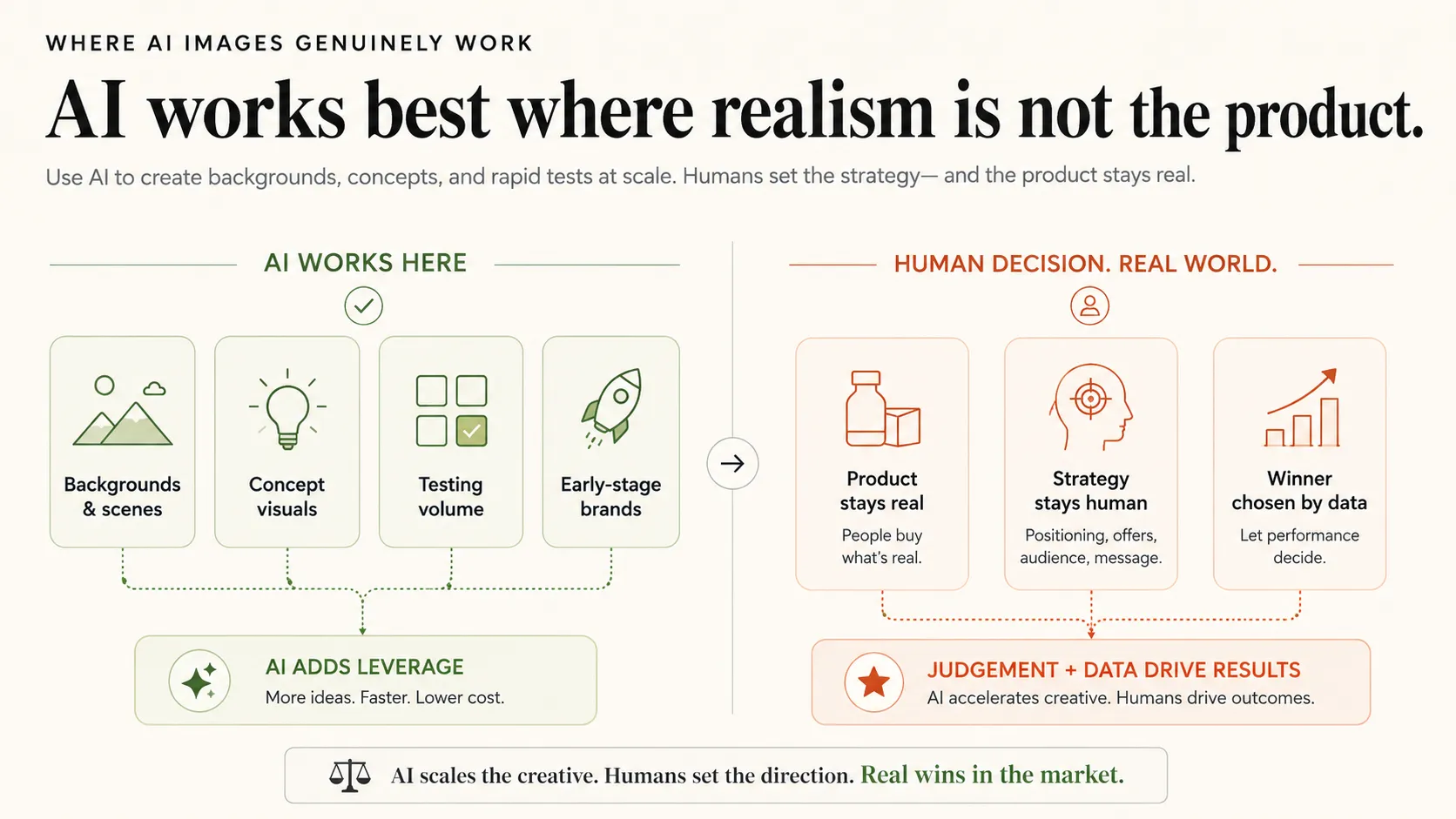
Backgrounds and scenes. Drop a real product into an AI-built setting. A candle on a styled mantel that was never photographed. A serum bottle on marble that doesn't exist. This works because the thing being sold is real, and only the room around it is invented. The customer judges the product; the background just sets a mood.
Concept and abstract visuals. Some ads don't lean on a literal product photo at all. Pattern interrupts, bold graphic fields, surreal imagery built purely to halt a thumb mid-scroll. AI fits naturally here, because nothing is pretending to be a real photograph of a real object, so there's no realism to break.
Volume for testing. This might be the strongest case of all. Good testing needs lots of variations, and AI produces them cheaply. Make fifteen background options or ten visual directions, run them, let the data pick the winner.
When each creative variation costs pennies instead of a half-day shoot, you can test more ideas in a week than most brands test in a quarter.
Early brands with no budget. A brand that can't afford a proper shoot yet can launch with decent AI visuals, earn some revenue, and put real money into photography later. Live and imperfect beats polished and hypothetical.
The thread tying these together is simple. AI images shine when realism isn't carrying the weight — set a scene, grab attention, fill a testing pipeline. They get into trouble the moment you ask them to be the honest, literal picture of what shows up on the customer's doorstep.
Where They Quietly Hurt Performance
The wins are loud. The failures are quiet, and that's exactly what makes them dangerous. An AI image that kills conversion doesn't look broken — it looks fine, runs normally, and loses you money in a way you'll probably blame on targeting.
Start with the trust gap on the product itself. When AI renders the actual thing someone is buying, not the backdrop but the product, little lies sneak in. A texture that's slightly off. A detail that won't match the box. A finish so flawless it reads as fake. The customer may not catch it consciously, but the wrongness registers, and trust thins out at the precise second you're asking for a card number. And if the ad shows a product that doesn't match reality, congratulations — you've just built yourself a returns problem.
Then there's the uncanny-valley issue with people. AI humans have gotten better fast. Hands, teeth, eyes, the way a sleeve folds: still frequently wrong, in that specific way that makes a brain whisper something is off here. In an ad meant to build trust, a not-quite-right face does the opposite of what you hired it for.
An AI-generated face costs nothing to make and quietly makes a small share of viewers uneasy without knowing why.
Anything with models in it, real photography still wins, and it isn't close.
Sameness is the third one, and it's getting worse. More brands, same handful of tools, same training data underneath. The output drifts toward one recognizable look — same lighting, same sheen, same "yeah, that's AI" feeling. Scroll a feed full of it and the AI ads melt into each other, which defeats the entire reason you make ad creative in the first place. The tool sold to you as a way to stand out can quietly turn you into wallpaper.
Last one, and it's growing: platform and disclosure risk. Ad platforms are rolling out AI-content labels. How people feel about an obviously-AI image runs from neutral to openly annoyed depending on the category. A label that flags your ad as AI can carry a real credibility cost, and how big that cost is swings hard by audience and product.

What the Testing Actually Shows
Put aside the true believers and the haters, and look at what brands find when they actually run the test. The pattern is reasonably consistent, and it hands neither side a clean win.
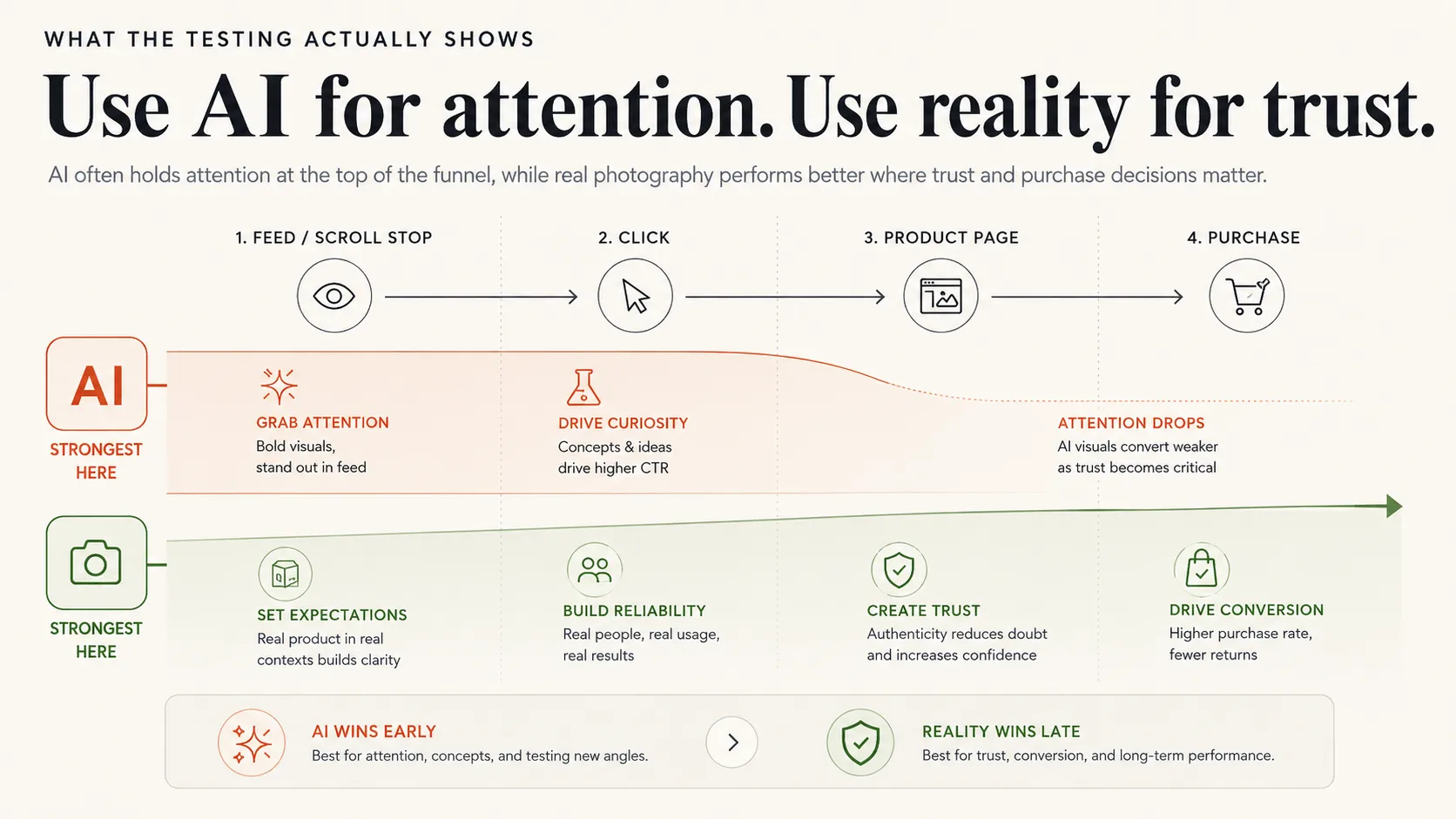
At the top of the funnel, AI visuals tend to hold their own. Click-through, engagement, scroll-stopping power. For grabbing a moment of attention, a striking AI image goes toe to toe with a photographed one, because attention doesn't require trust yet. Nobody's deciding to buy at that stage — they're just deciding to look.
The gap opens up lower down. On conversion rate, and especially on return rate and how happy people are after the box arrives, AI imagery that misrepresents the product tends to slip. Strong clicks, softer purchases, more stuff coming back. The image won the attention fight and lost the trust fight — and the trust fight is the one that pays.
Which lands you on a rule that survives across categories:
Use AI for the part of the ad that grabs attention, and reality for the part that earns trust.
In practice that means AI backgrounds, AI concepts, and AI test variations are mostly safe and often smart. The hero shot of the real product, and anything with a real person in it, is where an actual camera still earns its keep. The brands getting real mileage out of AI imagery aren't the ones who handed it the whole creative process. They're the ones who figured out which jobs it's good at and drew a hard line at the ones it isn't.
How to Use AI Images Without Damaging Conversions
The useful question was never "should I use AI imagery." It's "how do I use it without quietly taxing my own numbers." A few rules keep it on the right side of that line.
Keep the product real. Generate backgrounds, scenes, and context to your heart's content. Don't let AI invent the actual product someone's paying for. Use a real photo of the real thing, dropped into an AI setting if you like the look.
Skip AI humans where trust is on the line. Testimonials, models, anything where a person's realness is doing the selling: shoot a real person. The uncanny-valley gamble isn't worth what you save.
Test it, don't assume it. Don't flip everything to AI on faith, and don't refuse it on principle either. Run AI creative directly against real creative and let conversion and return data settle it. Click-through alone will lie to you in AI's favor, so look past it.
Watch the whole funnel. An AI image with a beautiful CTR and an ugly return rate is a loss wearing a win's clothing. Judge creative on what happens after the click, all the way through to whether the customer actually kept the thing.
Stay ahead of the disclosure rules. Keep half an eye on platform labeling policies and on how your particular audience reacts to AI content. What plays fine in one category can cost you credibility in another.
A Tool With a Job, Not a Replacement
AI-generated images aren't a yes-or-no call for paid ads, and the people treating them as one get it wrong from both ends. "The future of all creative" is wrong. So is "fake garbage that never works." They're a tool with a specific set of jobs they handle well: setting scenes, building concepts, and feeding the volume that honest creative testing needs. They've got an equally specific set of jobs they handle badly: showing the real product, showing real people, and standing in as the proof a customer needs before spending money.
The brands that win with AI imagery get that split and build around it — AI where attention is the goal, reality where trust is the goal. The brands that lose are the ones chasing the savings so far that they let AI render the exact things that decide whether a stranger trusts you enough to buy. Making the image is free. The trust you lose is not. Pointed at the right job, AI imagery is a genuine edge. Pointed at the wrong one, it's a cheap shortcut that shows up later as a number you won't think to trace back to the cause.