
Paid Ads


Vsevolod Hryhorenko
CMO & Co-founder
The Ad That Worked, Until It Didn't
Every brand has one. The ad that carried the account for a stretch. Cost per purchase sat where you needed it, the ROAS held, and for a few weeks you didn't have to think about creative at all. Then the numbers started drifting. Not a crash, just a slow slide. CPM up a bit, click-through down a bit, cost per purchase creeping past the line where the math still works.
The first instinct is to look anywhere except the ad. Targeting must have broken. The algorithm changed something. Competitors are bidding harder. Occasionally that's true. Far more often the ad simply ran its course, which is what ads do, and the only thing that actually went wrong is that nothing was ready to take its place.
Creative Fatigue Is a Countdown, Not a Failure
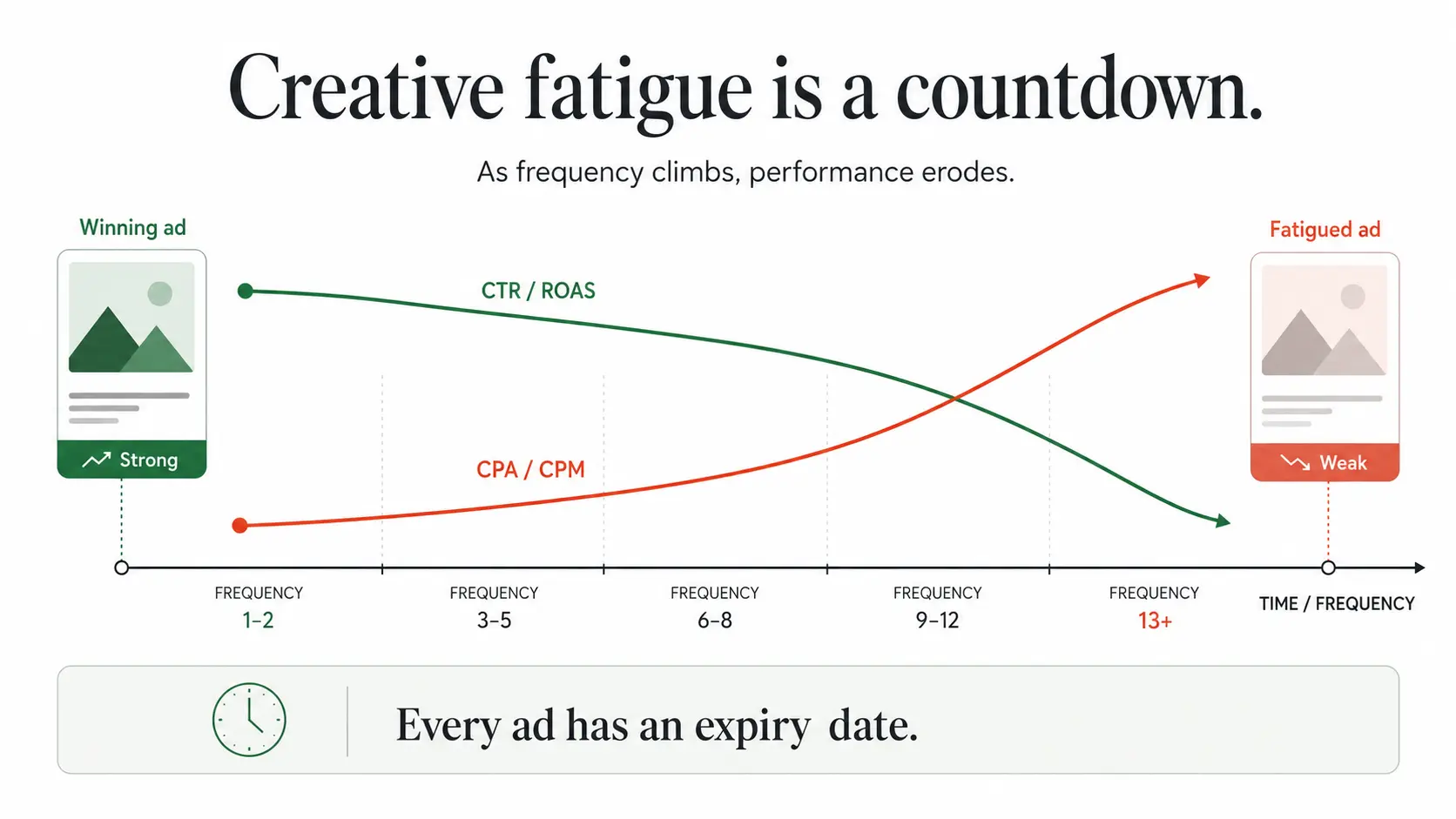
An ad doesn't stop working because it got worse. It stops working because the people who were going to respond to it already did.
Your audience is finite. Every impression spends a little of it. Early on, the ad reaches people seeing it fresh, and the ones it speaks to convert. Keep running and the pool of fresh viewers shrinks, frequency climbs, and increasingly you're paying to show the same message to people who already saw it and shrugged. Performance doesn't fall off a cliff. It erodes.
Then the platform makes it worse. Meta and Google both read engagement as a quality signal, so as click-through and conversion rates soften, the auction gets more expensive to win for the same placement. Now you're getting fewer conversions and paying more for each impression that produces them. The decay feeds itself.
Every ad has an expiry date. The only variable is how fast you spend your way toward it.
Which is why budget changes the timeline completely. An ad running at $50 a day might hold up for two months, because it's working through the audience slowly. Push the same ad to $500 a day and it can burn through that same audience in ten days. Brands that scale spend without scaling creative production run into this hard, and usually blame the scaling.
Most "Creative Testing" Isn't Really Testing
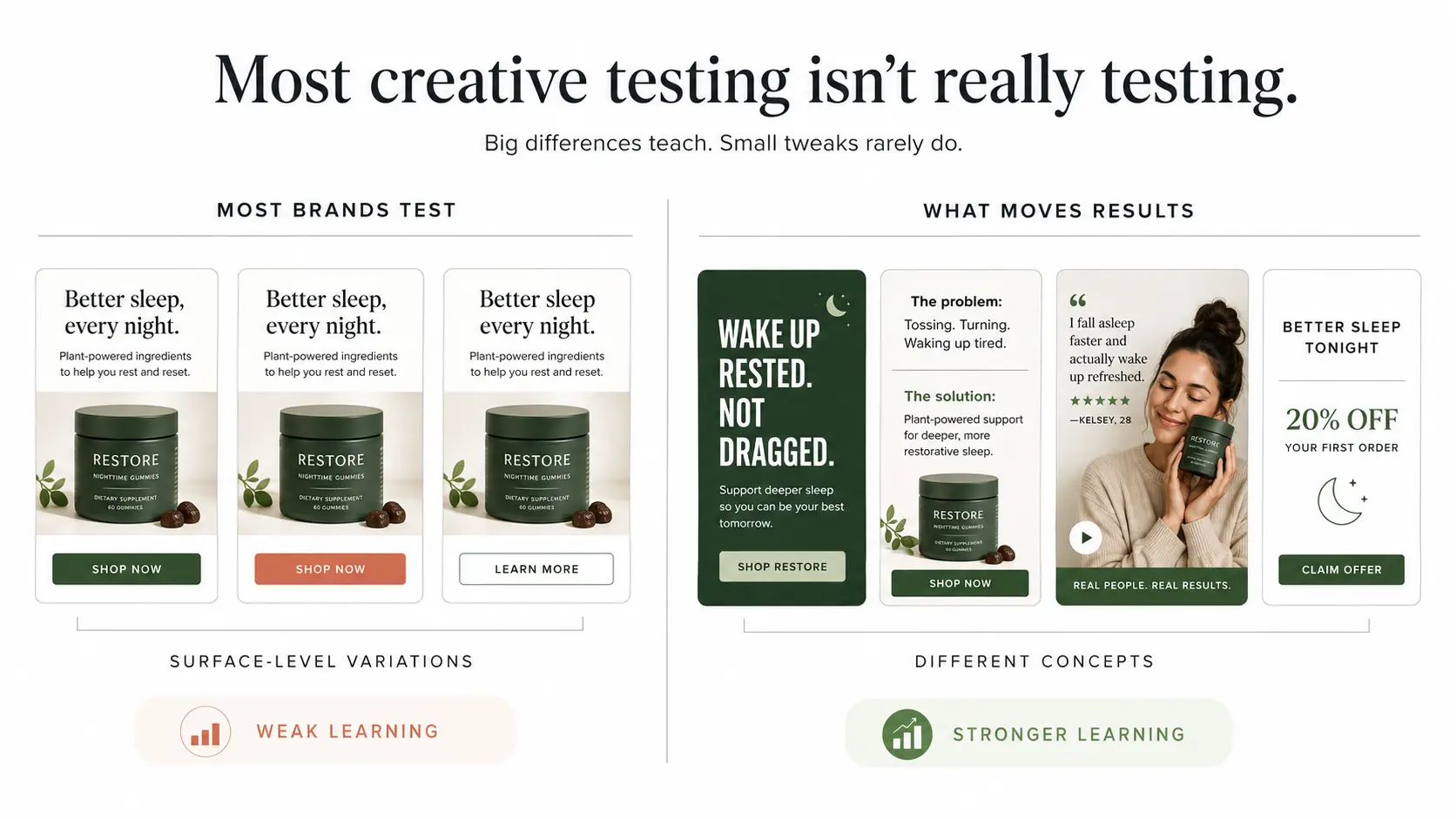
Ask ten brands if they test creative and nine will say yes. Look at what they're actually running and most of it isn't testing in any useful sense. A few patterns come up over and over.
Testing variations instead of concepts. Two ads with the same video, same hook, same angle, and a different button color. Whatever difference that produces is smaller than the natural noise in your data, so you end up "learning" something that was random. Meanwhile the thing that would have actually moved the number, a completely different angle, never got tried.
Not enough at once. Testing one new ad against your control, waiting three weeks, then testing one more. At that pace you get maybe fifteen shots a year. The brands finding winners consistently are running four or five genuinely different concepts per cycle, because most concepts lose and you need volume to find the ones that don't.
Calling it too early. Day two, one ad is ahead, so it gets the budget. On twelve conversions, that lead means nothing. Ads swap places constantly in the first few days while the algorithm is still figuring out delivery. Killing on early data is how good creative gets thrown away.
No hypothesis. This is the expensive one. An ad wins, it goes into the account, and nobody can say why it won. So the next batch is guesswork all over again, and the one before it taught you nothing. A test you can't explain didn't teach you anything, it just gave you one ad.
The point of testing isn't to find an ad. It's to find out what your audience responds to, so the next five ads start closer to the target.
Test the Big Things First
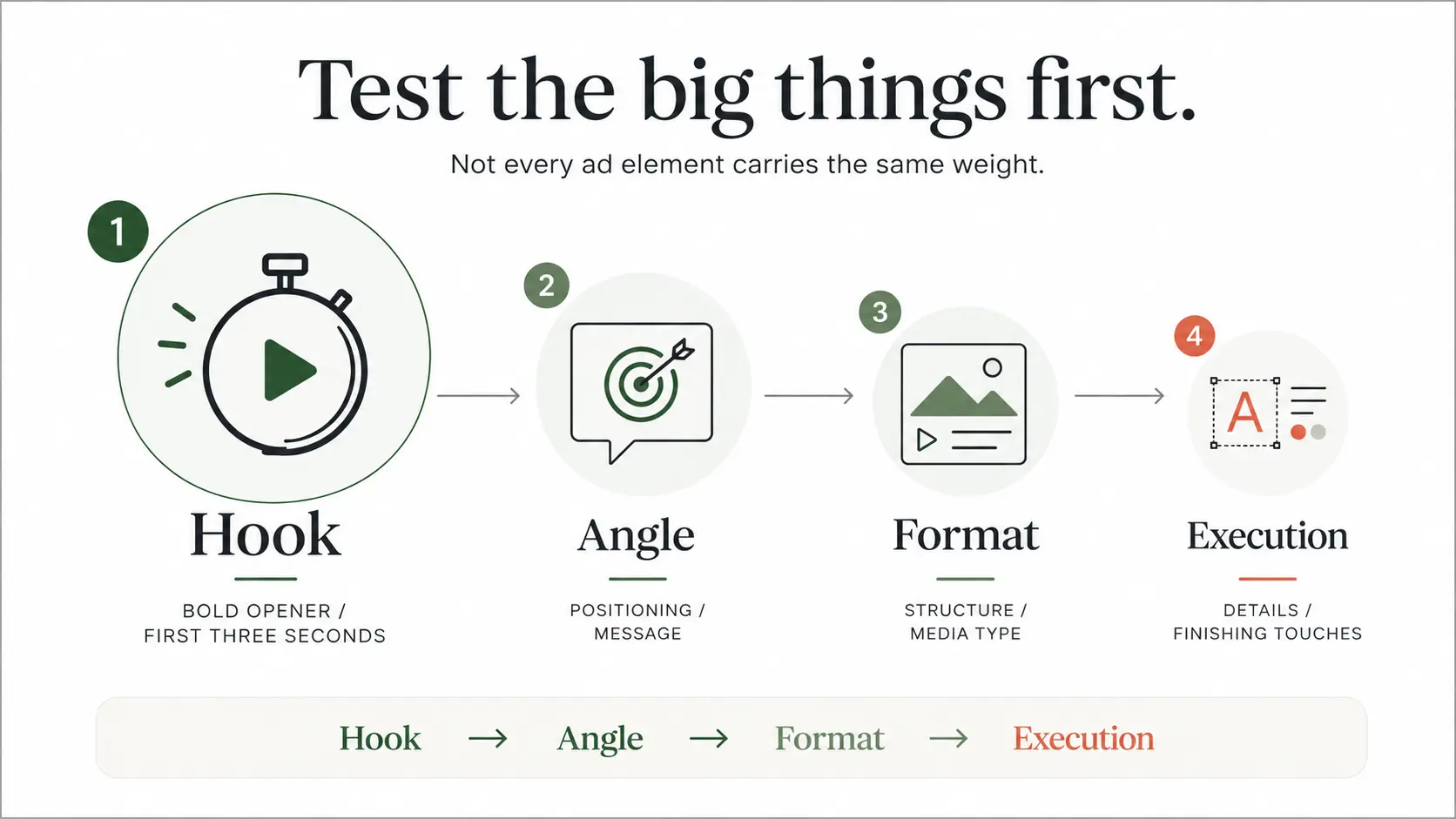
Not every element of an ad carries the same weight, and the gap between them is bigger than most people expect. There's a rough hierarchy, and it's worth working through it in order.
1. The hook. The first three seconds of a video, or the first line of a static. This decides whether anything else in the ad gets seen at all, which makes it the highest-leverage thing you can change. The same product, same offer, same everything else with a different opening can produce double the results.
2. The angle. What problem you're claiming to solve, and who you're claiming to solve it for. A skincare product sold on "clears breakouts in two weeks" and the same product sold on "the routine that takes 30 seconds" reach different people with different motivations. This is a positioning test disguised as a creative test, and it often teaches you more about your customer than anything in your analytics.
3. The format. Video against static. Rough phone footage against polished studio work. Carousel against single image. Format shifts how the message lands, and the winner is frequently not the one that cost more to make.
4. Execution details. Copy tweaks, colors, CTA wording, music. These are real, and they're worth optimizing once the bigger decisions are settled. They're also where most brands start, which is why most brands see small results from testing.
Work top down. A brilliant hook on a weak angle still underperforms a decent hook on the right angle, and no amount of button-color testing rescues either.
Building a Cadence That Keeps Up
Knowing what to test matters less than testing on a schedule that outruns fatigue. That's an operational problem more than a creative one, and it's where accounts either build momentum or stall.
Run three to five genuinely different concepts per cycle. Different means different hooks and different angles, not the same idea in five outfits. Expect most of them to lose, because they will, and that's the normal cost of finding the ones that don't.
Give each test long enough to mean something. In practice that's usually a week, or roughly 50 conversions per variant, whichever comes first. Below that you're reading noise and making decisions on it.
Carve out budget specifically for testing and stop raiding it. Ten to twenty percent of spend, ringfenced, treated as the cost of having ads to run next month. When testing budget gets absorbed into whatever's currently winning, the pipeline dries up, and you find out about it three weeks later when the winner fades and there's nothing behind it.
The ceiling on most accounts isn't budget or targeting. It's how fast the brand can make new creative worth testing.
That last part is the one people underestimate. A brand producing eight new concepts a month can keep a growing budget fed indefinitely. A brand producing two is going to hit a wall, and no amount of bidding optimization fixes a supply problem. If creative production is the constraint, the fix is production capacity, not media buying.
Treat It Like Manufacturing, Not Inspiration
The brands that consistently outperform on paid social usually aren't more creative than everyone else. They're more systematic. They know their winners have a shelf life, they have replacements in testing before the current one fades, and they've built a process that turns out new concepts on a schedule instead of waiting for a good idea to show up.
That reframes the whole job. Creative testing isn't a burst of inspiration you get lucky with occasionally. It's a production line: a steady flow of hypotheses, tested properly, killed quickly when they lose, scaled carefully when they win, with each round teaching you something that makes the next round smarter. Your best ad is going to stop working. The only real question is whether the next one is already in testing when it does.