
Marketing


Mykyta Hryhorenko
CEO & Co-founder
The Promise That Makes You Want to Sign
Picture the sales call. You've been burned by an agency before, or maybe you're just new to this and the idea of wiring someone a few thousand dollars a month for "marketing" makes your stomach tighten. And then the person on the other end says it: "We guarantee results. If it doesn't work, you don't pay." Something in your shoulders drops. Finally, someone confident enough to put themselves on the hook.
That relief is the product. The guarantee isn't only a promise about the work — it's the thing engineered to get your signature on the page before you've thought too hard, and the two purposes don't always point the same direction. Some guarantees are exactly what they look like: a confident team backing itself with a fair deal. Others are a sentence built to sound like a safety net while quietly leaving a door open for the agency to walk out of. They read almost identically on a sales call. The whole game is learning to tell which one you're actually being handed.
Why the Word Should Slow You Down, Not Settle You
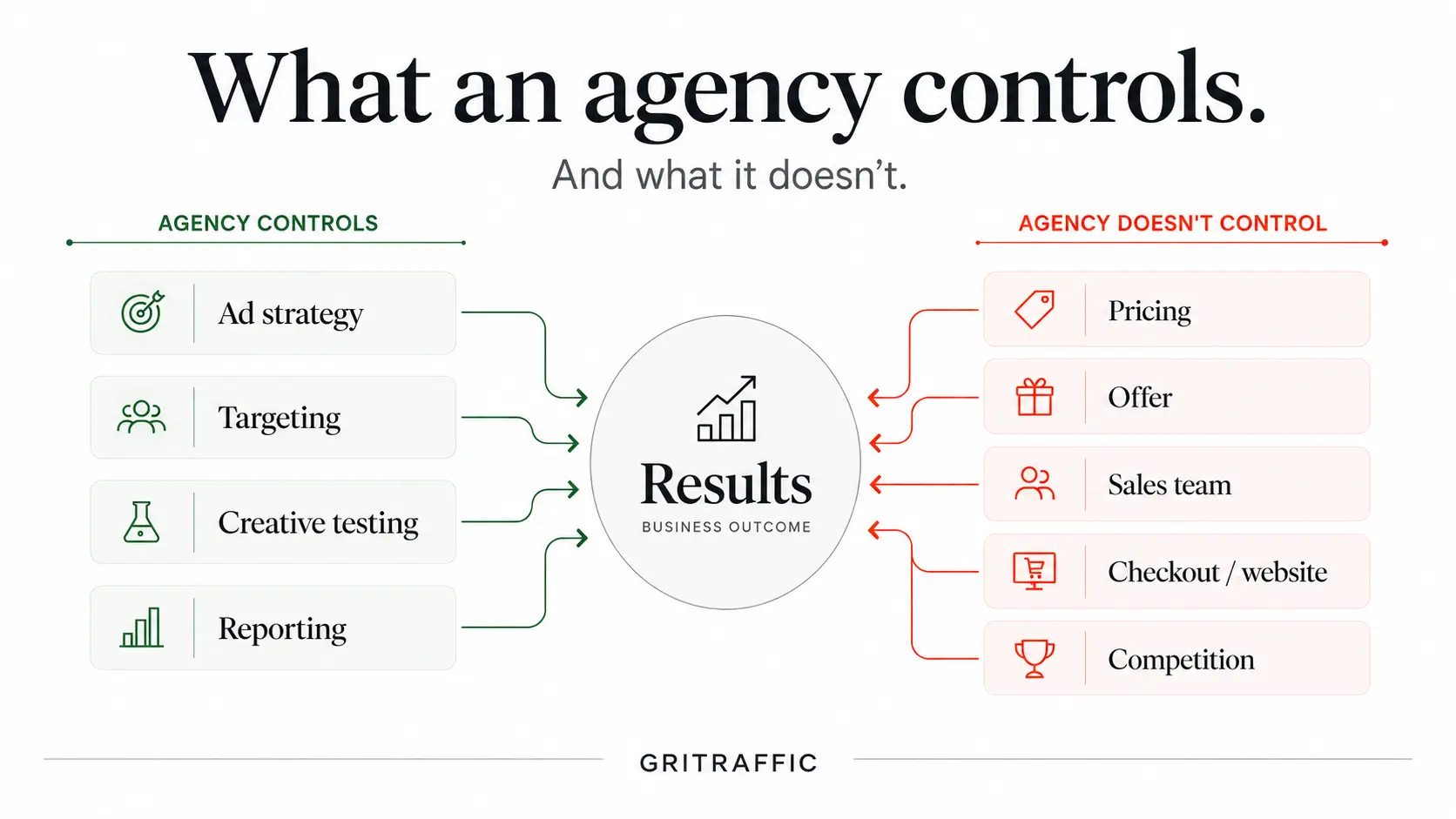
Here's the part nobody says out loud on the call, because it doesn't help close: in marketing, the outcome that actually matters to you cannot be honestly guaranteed by anyone. Not because agencies are dishonest, but because the result depends on a chain of things most of which the agency never touches.
They run the ads. They don't set your prices. They don't build the checkout that drops half your buyers on the payment step. They don't answer the phone when a lead calls, and they don't decide whether your offer is even competitive against the three other companies that person is comparing you to. An agency can do its job flawlessly — send you genuinely interested, well-qualified people — and still watch your business fail to convert them for reasons that live entirely on your side of the fence. That's not an excuse. It's just how the responsibility actually splits, and any agency pretending otherwise is either overselling or hasn't thought about it clearly.
Which flips the whole thing around. A big, bold guarantee on a hard sales number isn't the reassurance it feels like. It usually means one of two things — the promise is worded loosely enough to escape, or the person making it doesn't understand their own limits. The agencies actually worth your money tend to do the opposite of the confident pitch. They get careful. They tell you what they can and can't promise, and that carefulness ends up being far more reassuring than the guarantee ever was.
Where the Trick Usually Hides
Once you know that the outcome can't be cleanly guaranteed, you start noticing how the weaker guarantees get around that inconvenient fact. They don't lie, exactly. They just attach the promise to something that sounds meaningful and isn't, or bury the escape hatch where you won't look until you need it.
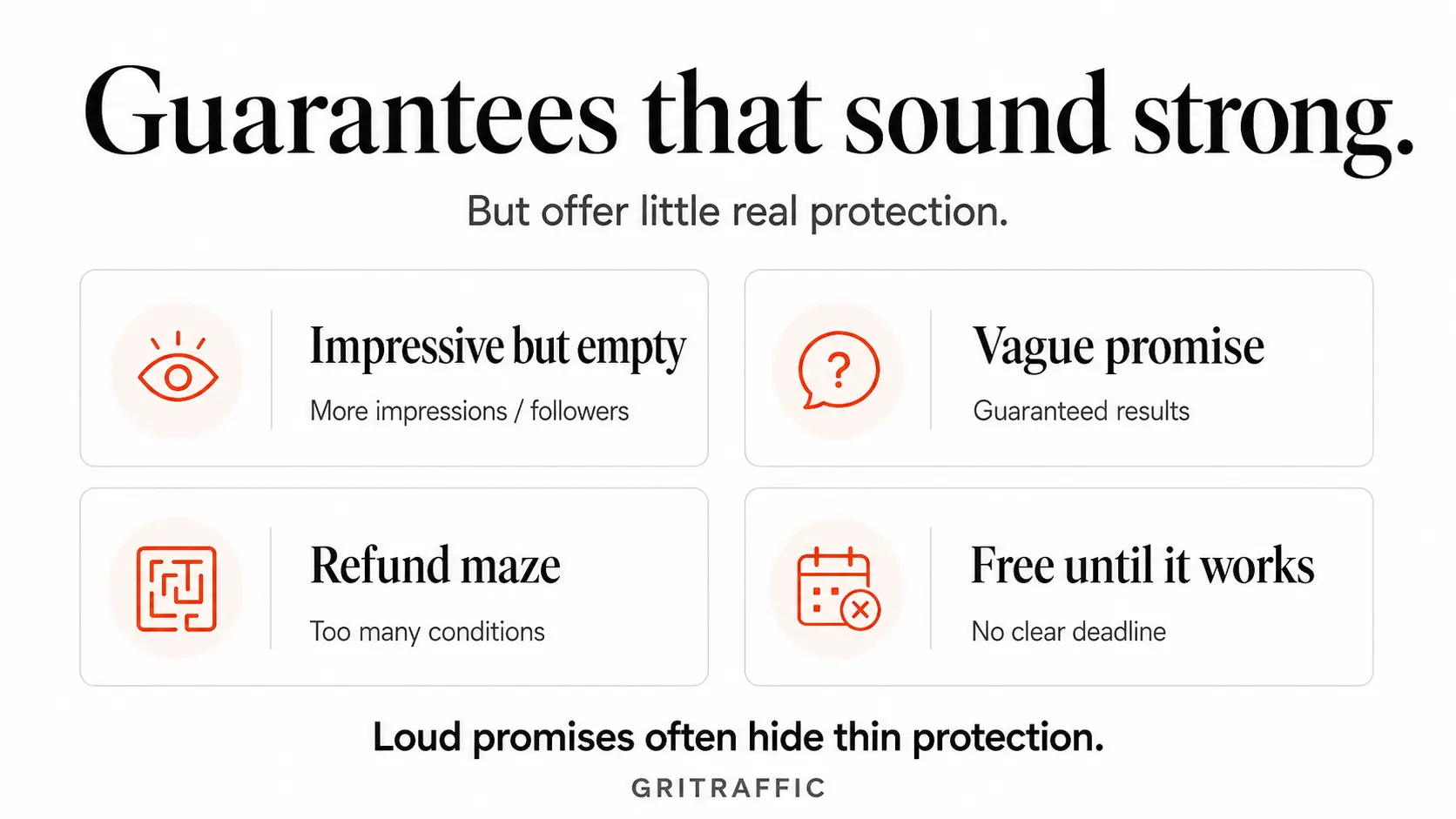
A few of the moves are common enough to name on sight:
The impressive-but-empty number. "Guaranteed to double your impressions." "10,000 new followers, guaranteed." Both are easy to deliver and neither has much to do with money in your account. Reach and followers can be bought for pennies and mean almost nothing about whether the business grows.
The promise with no edges. "We guarantee results." No metric, no deadline, no method of measuring. You can't hold anyone to a sentence that vague, because when the time comes there's nothing specific to point at.
The refund you can't actually collect. The clause is real; the conditions are a labyrinth. Follow every recommendation to the letter, send assets within 24 hours every single time, keep spend above some line, and file inside a five-day window. Technically a guarantee. In practice, a maze with no exit.
The "free until it works" arrangement. Sounds generous, sometimes is. But an agency working for free has every reason to put you last, and "until it works" with no deadline attached can quietly mean never.
The pattern underneath all four is almost funny once you see it: the thinner the actual protection, the louder the language tends to get. When a guarantee is doing real work, it usually sounds modest. When it's doing sales work, it shouts.
What an Honest One Sounds Like Instead
The good version is quieter, and it gives itself away by getting specific exactly where the weak ones stay vague.
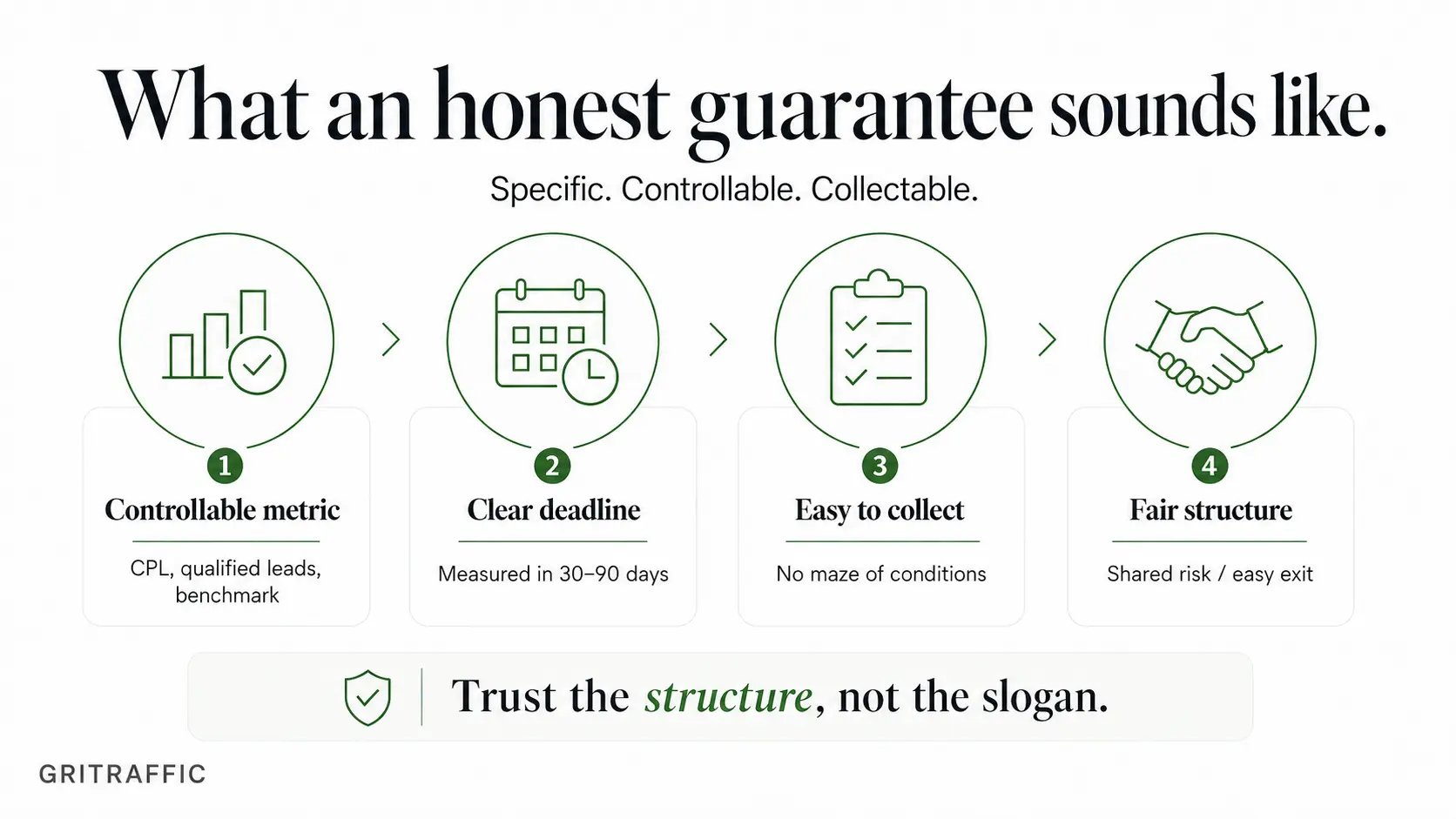
An honest guarantee attaches itself to something the agency actually controls. Not your sales — the input they're responsible for. A cost per qualified lead. A volume of leads at an agreed quality. Performance measured against a named benchmark. And it comes with edges: a real metric, a real deadline, a real way to check. "Cost per lead under $40 within 90 days, measured in your CRM" is a guarantee you can hold in your hand. Both sides know precisely what winning looks like and precisely when it gets judged, and there's no reinterpreting it after the fact.
Then it's collectable like it was meant to be honored — reasonable conditions, a simple process, no buried exit.
But here's the thing worth sitting with. The most honest arrangement often isn't a dramatic "guarantee" at all. It's just a fair structure that shares the risk instead of pretending to erase it. A lower rate for the first month while things ramp up. No long lock-in, so you can leave the moment it stops working. A performance clause tied to a number the agency can actually move. That kind of deal never shouts guaranteed across a sales page. It just quietly points both of you at the same outcome — which, when you think about what you actually want from a partner, is the entire point.
Make Them Answer Four Things
You don't have to untangle any of this in your head on the call. You just have to ask, and then watch how they respond — because the answers tell you more than the guarantee ever could.
Ask exactly what metric they're guaranteeing and how it's measured. An honest agency has that answer immediately and in specifics; hesitation or a slide back into how great their results are usually means the guarantee was never solid to begin with. Ask what you'd have to do to actually collect — and listen for a long list of strict conditions with tight deadlines on your side, which is how you spot the maze before you're in it. Ask them to walk you through what happens if it doesn't work, and notice whether they've clearly been here before or whether the question makes them shift in their seat.
And ask the one that often matters most: can I leave if I'm not happy, or am I locked in? Sometimes the real protection was never the guarantee at all. It's the absence of a twelve-month contract. The freedom to walk away when results don't show up is worth more than almost any guaranteed-results clause, for the simple reason that it can't be worded around.
Trust the Structure, Not the Slogan
So, should you trust an agency that guarantees results? Wrong question. A guarantee isn't a green flag or a red one — it's a document, and it's worth exactly what its structure is worth and not a word more. The loud ones with soft terms protect the agency. The specific ones tied to controllable metrics, with fair conditions and a clear way out, protect you. "Guarantee" on its own tells you nothing.
If anything, lean the other way from your instinct. Be more wary when the promise sounds too good, not less, because the outcomes that genuinely matter here can't be promised with certainty by anyone being honest with you. What a real partner offers isn't certainty — it's a fair structure, incentives that line up with yours, straight talk about what they control, and an open door if it isn't working. Trust that. And read every guarantee that sounds like a shortcut with your eyes all the way open.