
Google Ads


Vsevolod Hryhorenko
CMO & Co-founder
The Traffic Is There. The Results Aren't
Clicks without conversions is one of the most demoralising patterns in paid advertising. The campaign is running, the budget is spending, the traffic is coming — and nothing is happening on the other end. The natural instinct is to assume the ads aren't working. In most cases the ads are doing exactly what they're supposed to. The problem is elsewhere.
Google Ads is a traffic system, not a conversion system. Its job is to connect a search query to an ad, and bring someone to your site. What happens after that click — whether the visitor becomes a lead, a customer, or a bounce — is determined by factors the ad itself can't control: the quality of the match between what the ad promised and what the page delivers, the clarity of the offer, the presence or absence of trust signals, and whether the person who clicked was ever likely to convert in the first place. Most click-without-conversion problems trace back to one of these four areas.
The Keywords Are Attracting the Wrong People
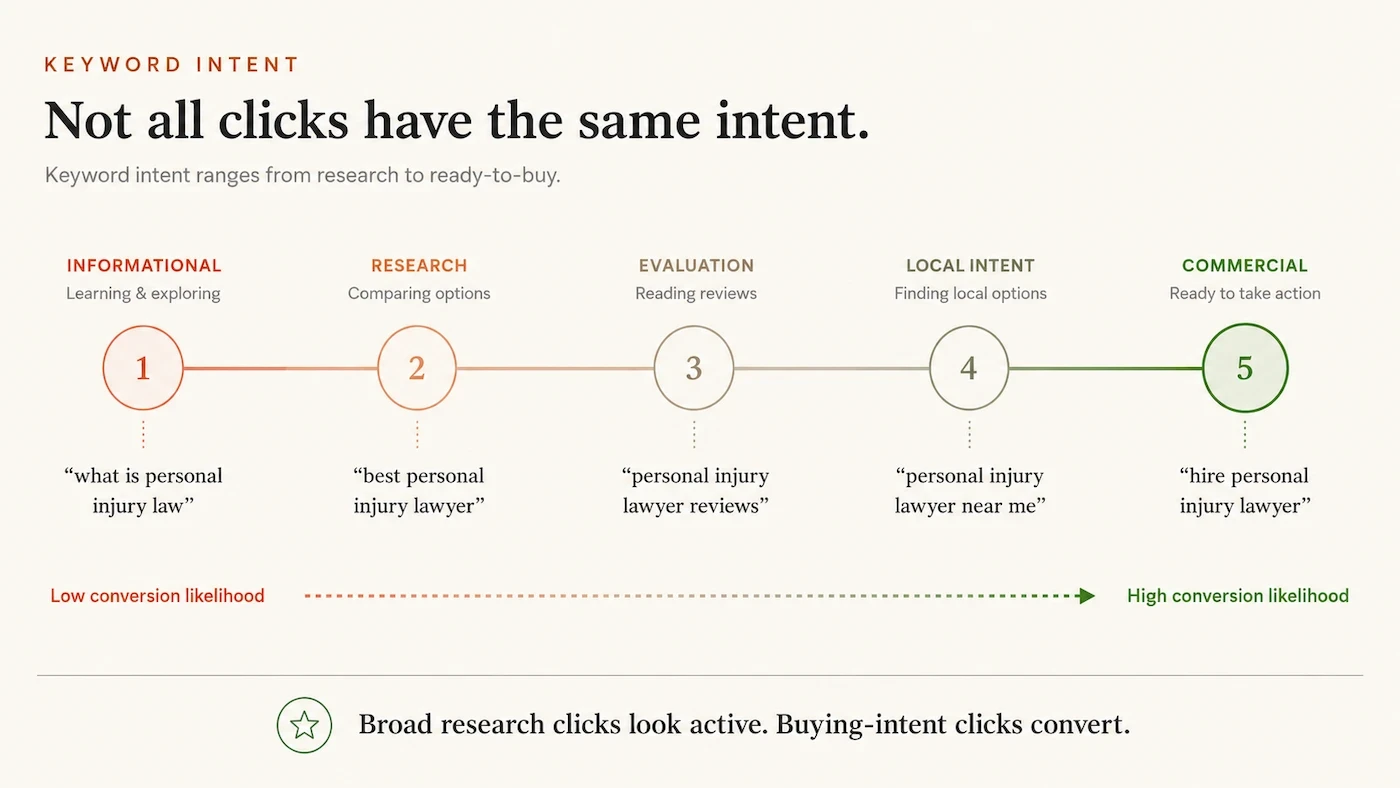
Keyword intent is the most underdiagnosed cause of high click, low conversion campaigns. Not all clicks are created equal — a click from someone actively looking to buy is fundamentally different from a click from someone doing research, comparing prices, or searching out of curiosity. When campaigns target broad or informational keywords, they generate traffic that looks healthy in a dashboard and produces almost nothing in a CRM.
The clearest signal of an intent mismatch is a high click-through rate paired with a high bounce rate and low time on page. People are clicking because the ad is relevant to their search — but they're leaving immediately because the page isn't what they were looking for. The ad did its job. The keyword choice didn't.
Intent-matched keywords for lead generation and e-commerce tend to share specific characteristics: they include buying signals ("buy", "price", "near me", "for hire", "quote"), they reference specific products or services rather than broad categories, and they often include qualifiers that filter for commercial intent. "Personal injury lawyer" has different intent than "what does a personal injury lawyer do." "Running shoes" has different intent than "best running shoes for beginners." Bidding on both without separating them into different campaigns — with different landing pages and different bids — means the budget that should be concentrated on high-intent traffic gets diluted across people who were never going to convert.
The Ad Promised Something the Page Didn't Deliver
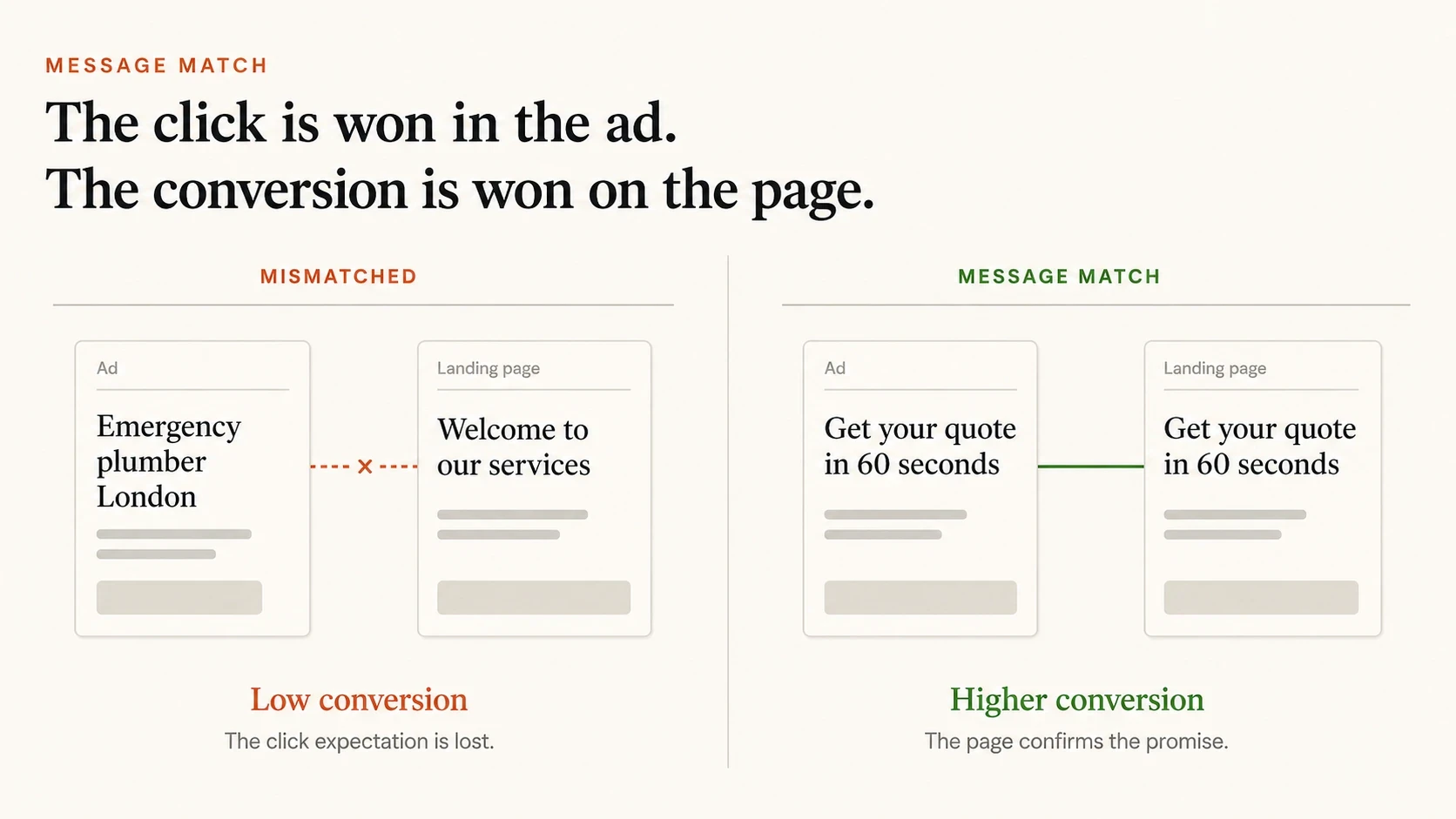
Message match — the degree of consistency between what an ad says and what the landing page says — is the single most common technical cause of click-without-conversion. When someone clicks an ad, they carry a specific expectation formed by the headline they just read. If the page they land on doesn't immediately confirm that expectation, most of them leave within seconds.
The failure modes are predictable:
Generic destination pages. An ad for "emergency plumber London" sending to the homepage of a general plumbing company. The visitor has to work to confirm that the business offers emergency services in their area. Most won't bother.
Mismatched headlines. An ad that leads with a specific benefit ("Get your quote in 60 seconds") landing on a page with a generic headline ("Welcome to our services"). The specificity that earned the click is absent on the page.
Offer inconsistency. An ad promoting a discount, a free consultation, or a specific product that isn't prominently featured — or isn't mentioned at all — on the destination page.
The fix in each case is the same: the landing page headline should mirror the ad headline closely enough that the visitor feels they've arrived in the right place. The offer stated in the ad should be the first thing visible on the page. The action being asked of the visitor should be singular and clear. Every step that requires the visitor to search for what the ad promised is a step where you lose them.
Trust Is Missing at the Moment of Decision
Someone who arrived via a paid search ad has, by definition, never chosen you over alternatives. They found your ad in a list of competitors, clicked, and are now evaluating whether to take the next step. At that moment, the absence of trust signals — evidence that other people have made this decision and it worked out — is often what ends the visit.
For e-commerce, trust signals include: recognisable payment logos, clear return and refund policies, product reviews with specific detail (not just star ratings), and evidence of real customers. For service businesses: client testimonials with names and outcomes, case studies with numbers, professional accreditations, and response time commitments. These elements don't need to be extensive. A single specific testimonial — "We reduced our cost per lead by 40% in the first month" — does more conversion work than a generic five-star rating.
Page speed is also a trust signal of a different kind. A page that loads slowly on mobile communicates, before a single word is read, that the experience is going to be effortful. At 3 seconds load time, a measurable percentage of visitors have already left. At 5 seconds, it becomes significant. Most of the visitors you're losing to slow load times aren't bouncing because of the page content — they never see the page content.
Bidding Strategy Is Working Against You
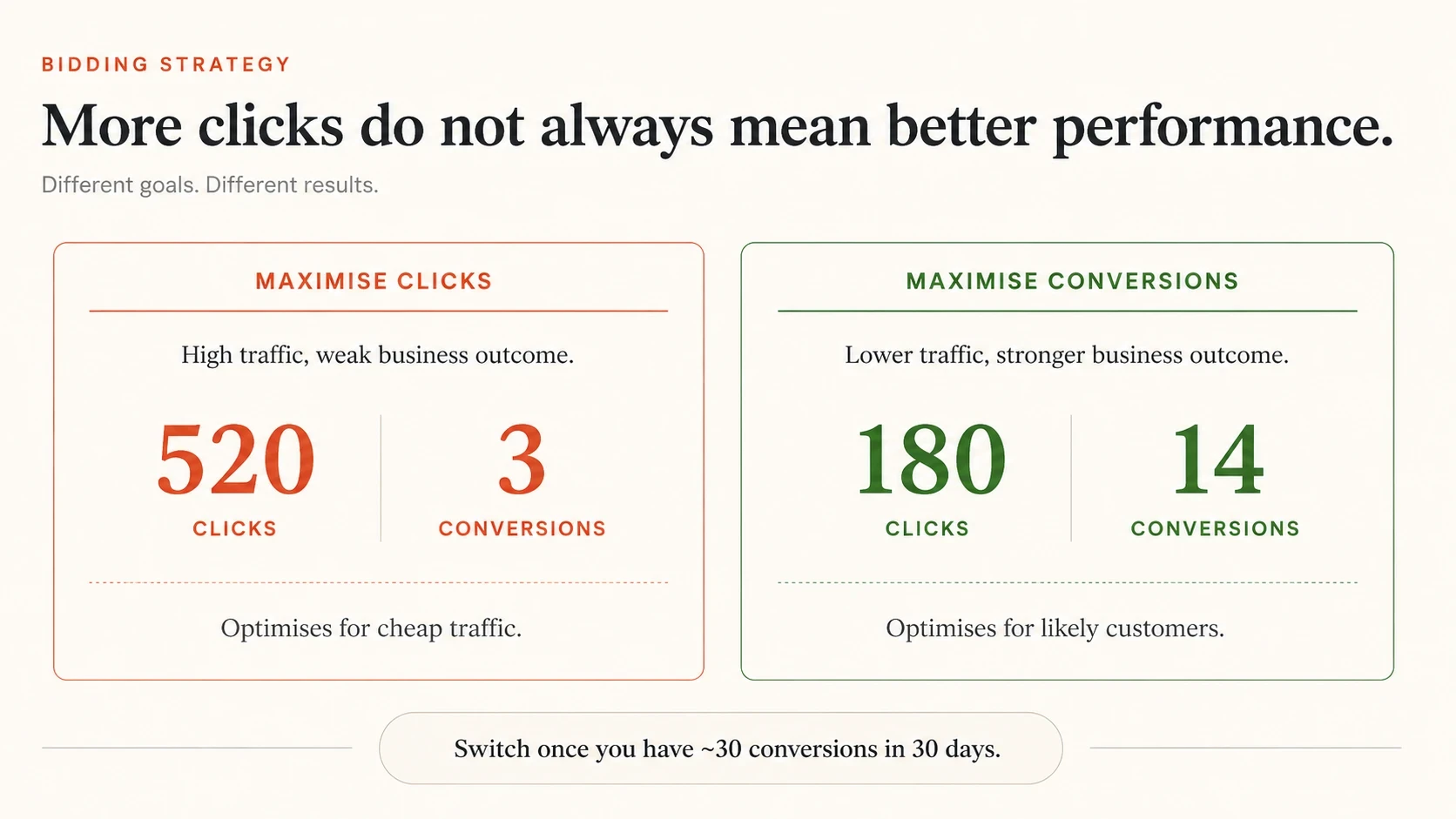
The final category of click-without-conversion problems is structural: the bidding strategy is optimising for the wrong thing. Maximise Clicks — a common default, and a tempting choice when you want to see traffic moving — tells Google to get as many clicks as possible within the budget. It does exactly that, without any regard for whether those clicks are likely to convert. The result is high click volume at low cost, generating traffic from whoever is cheapest to reach rather than whoever is most likely to become a customer.
Once there is conversion data in the account — ideally 30 or more conversions in a 30-day window — switching to a conversion-based bidding strategy (Maximise Conversions or Target CPA) changes what the algorithm is trying to do. Instead of finding cheap clicks, it starts finding clicks that look like previous conversions. CPCs often rise. Click volume often drops. Conversion rate improves. The business result is almost always better, even though the dashboard looks less impressive on a surface read.
Clicks Are a Starting Point, Not a Measure of Success
The shift that changes how Google Ads performs for most businesses is treating click volume as an input, not an output. Clicks are the raw material. What matters is what percentage of them convert, at what cost, with what quality. A campaign generating 500 clicks and 3 conversions is not performing better than a campaign generating 80 clicks and 12 conversions — but the first one often gets more budget because it looks more active.
Fixing a clicks-without-conversions problem almost never requires more spend. It requires identifying which of the four failure points — intent mismatch, message mismatch, trust deficit, or wrong bidding strategy — is doing the most damage, and fixing that first. One change at a time, measured correctly, produces clearer results than changing everything simultaneously and losing track of what worked.