
Paid Ads


Vsevolod Hryhorenko
CMO & Co-founder
The Wrong Way to Ask the Question
Every business that starts spending on paid ads runs into the same fork in the road. Google or Facebook? The question gets asked as if one of them is simply better, and the internet is happy to oblige with confident answers in both directions. Spend two hours reading and you'll find an equal number of people swearing Google is the only channel that matters and that Facebook is where the real money is.
They're both right, and that's the problem. The honest answer isn't that one platform beats the other. It's that they do fundamentally different jobs, and which one fits depends on what you sell, who buys it, and how people decide they want it. A business pouring its whole budget into the "better" channel — without asking whether that channel matches how its customers actually behave — is making the most expensive mistake in paid advertising, and the dashboard won't tell them for months.
They Work in Opposite Directions
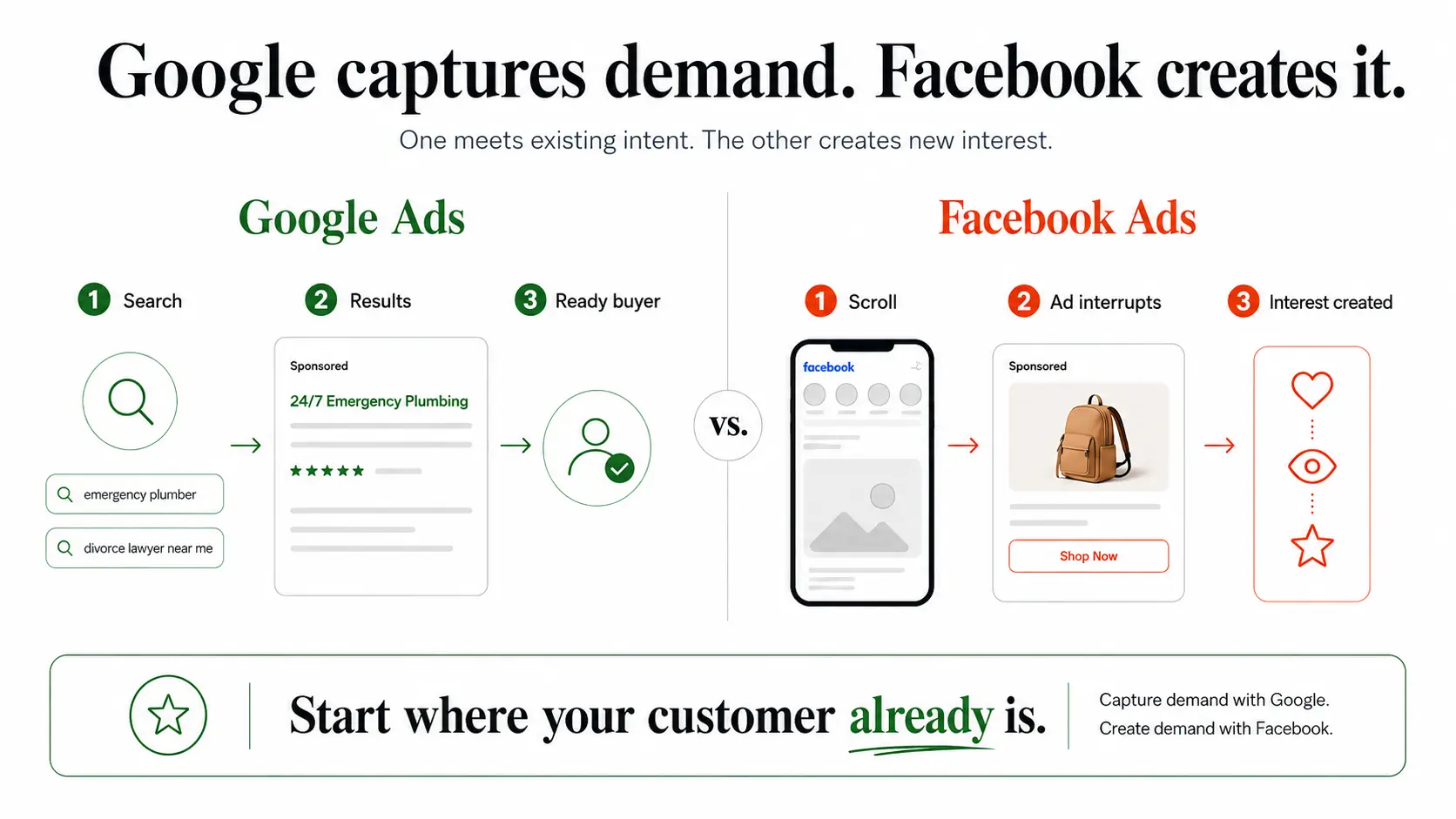
The core difference between the two platforms is so basic that it's easy to skip past, and almost every budget mistake traces back to ignoring it. One captures demand. The other creates it.
Google Ads is demand capture. Someone types "emergency plumber near me" or "best running shoes for flat feet," and your ad meets them at the exact moment they're looking. The intent already exists — you're just making sure you're the option they find. The person was going to search whether or not you advertised; your money decides whether you're in the room when they do.
Facebook Ads is demand creation. Nobody opens Instagram looking to buy your product. They're scrolling through photos of their cousin's holiday, and your ad interrupts them with something they didn't know existed. There's no pre-existing intent to capture — you're manufacturing interest from scratch, in someone who woke up that morning with no plan to buy anything from you.
Google finds people already looking for what you sell. Facebook finds people who'd want it if they knew it existed.
That single distinction drives almost everything else: who each platform suits, what creative each one needs, and how you measure whether it's working. Get this part right and the rest gets a lot simpler.
When Google Is the Right First Move
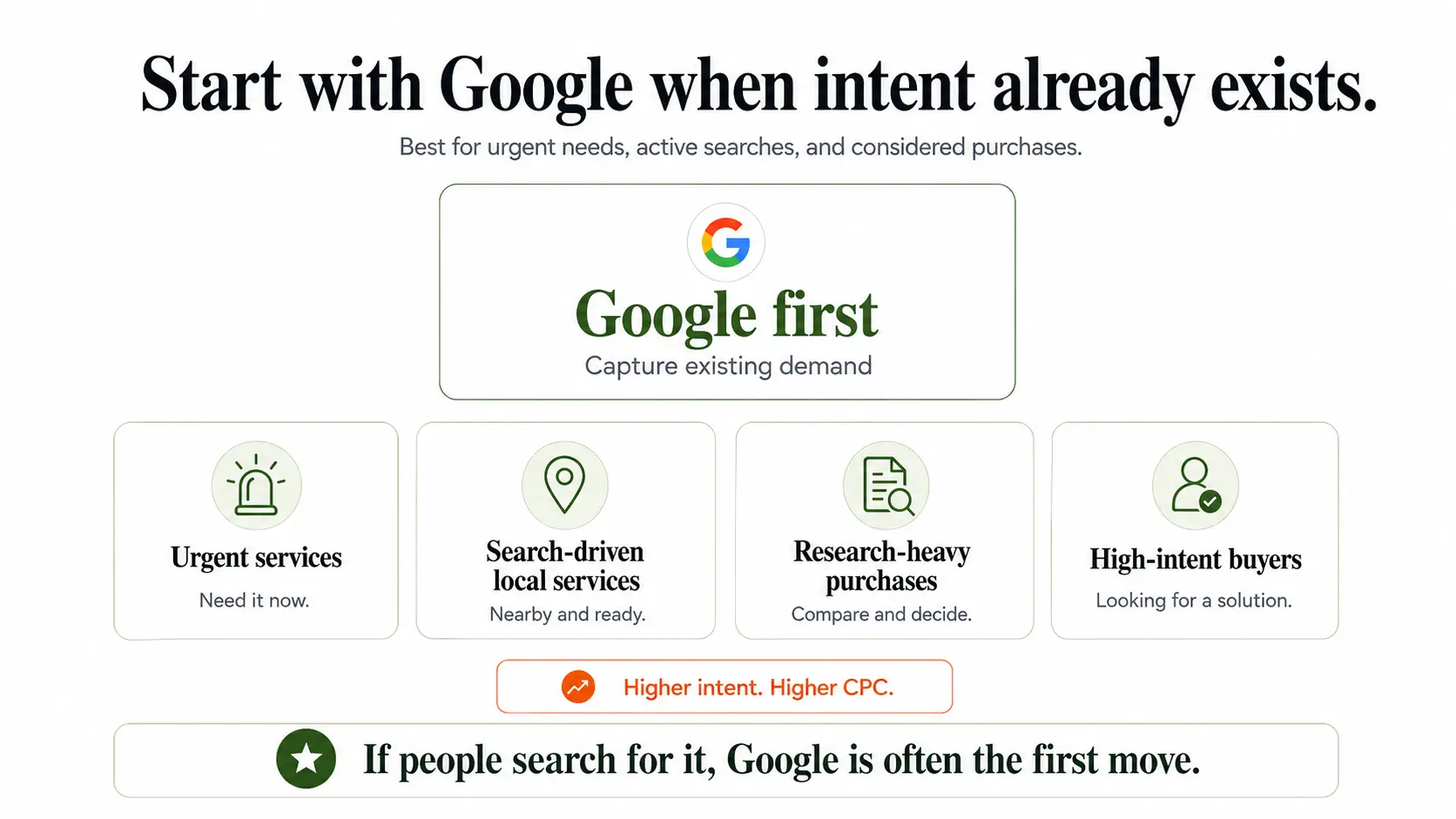
Some businesses should start with Google and barely touch Facebook until later. The pattern is clear once you know what to look for.
You sell something people actively search for. Plumbers, lawyers, locksmiths, dentists, "my boiler just died" emergencies. If a real person types your service into a search bar with intent to hire, Google puts you in front of them at the moment of need. That's the highest-quality traffic there is, because the buying decision is already half-made.
The need is urgent or problem-driven. Nobody gets talked into an emergency electrician through a clever video. They have a problem right now and they're searching for a solution right now. Demand creation is pointless here — the demand already exists and it's on fire.
The purchase is considered and research-heavy. Expensive or complex products where people search, compare, and read before buying. B2B software, professional services, high-ticket items. These buyers run searches, and Google catches them mid-research.
The catch with Google is cost. Because the intent is so valuable, everyone wants it, and the auction reflects that. Competitive keywords in law or insurance can run past $100 a click. Google often delivers the higher-quality lead — and charges you accordingly for it.
When Facebook Is the Right First Move
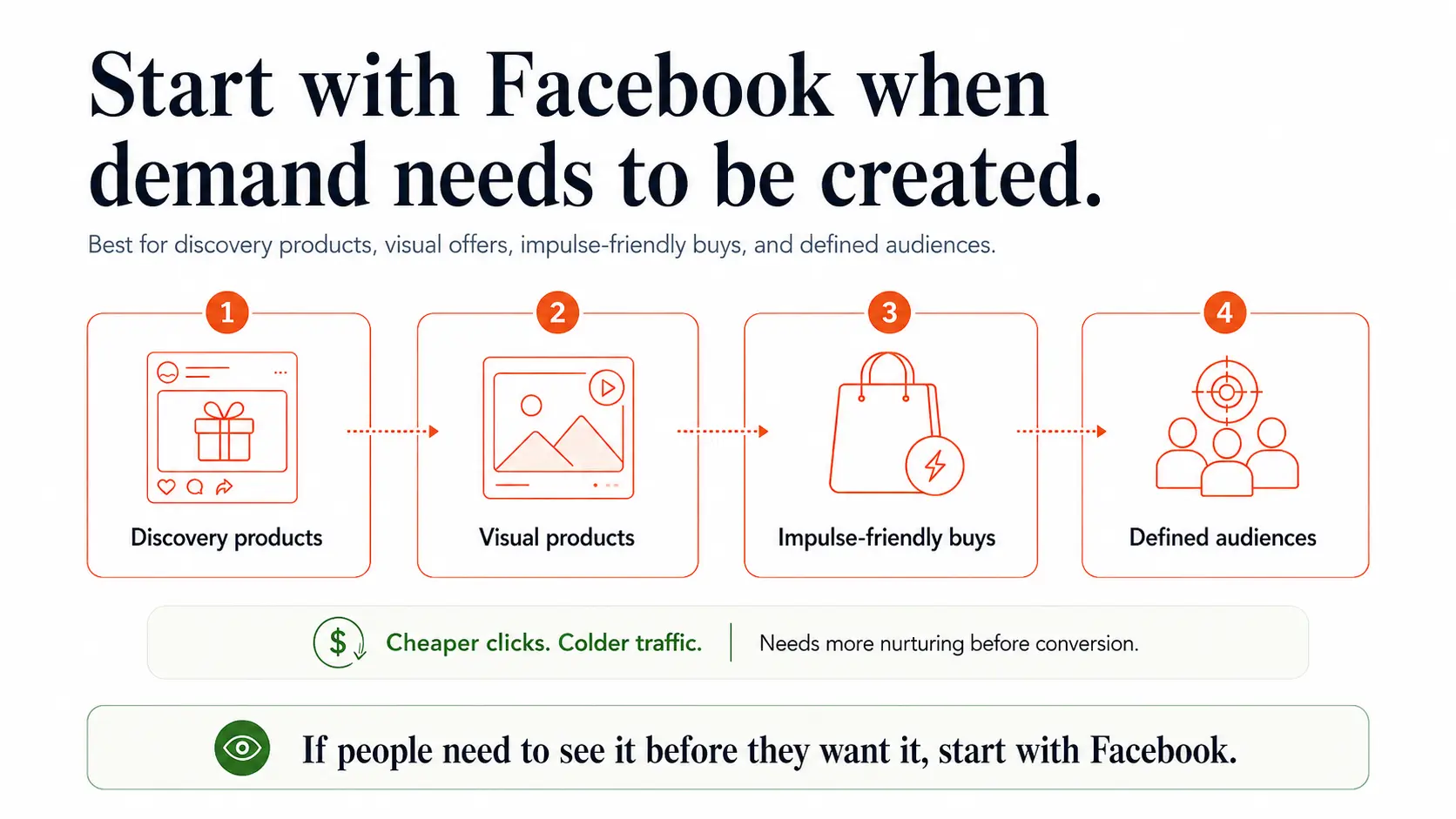
Other businesses would burn money starting with Google, because nobody is searching for what they sell yet. Facebook is where they belong.
You sell something people don't know to look for. A new product, a novel solution, an impulse buy, a "didn't know I needed this until I saw it" item. Nobody searches for a product category that doesn't exist in their head yet — so you have to put it in front of them. Search can't capture demand that was never there.
The product is visual or demonstrable. Anything that benefits from being seen in action. Apparel, home goods, beauty, gadgets, food. Facebook and Instagram are built for visual storytelling, and a strong video or image can manufacture desire in a way a text search ad never could.
The purchase is impulse-friendly and lower-priced. Products cheap enough to buy on a whim, where seeing it and wanting it can happen in the same thirty seconds. The lower the price and the lower the risk, the better Facebook's interruption model works.
You have a distinct audience you can describe. Facebook's targeting shines when you know exactly who your customer is. The platform finds people who resemble your best buyers, which works beautifully when you can define them clearly.
Facebook's strength is also its demand. Clicks are usually far cheaper than Google's, because you're reaching people who weren't actively looking — so the traffic is colder, and it takes more nurturing before it converts. Cheaper clicks, more work to turn them into customers.
Most Businesses Eventually Need Both
Framing this as a permanent either/or is itself a mistake. The two platforms aren't rivals fighting over the same budget — they cover different stages of how a customer comes to buy, and once a business is past its first phase, they work best together.
Here's how they stop competing and start compounding. Facebook creates awareness — someone sees your product, gets interested, but isn't ready to buy yet. They might search your brand name later to check you out, and a Google brand campaign catches them at that exact moment. Or they visit your site, don't convert, and a retargeting campaign on either platform brings them back. The customer journey runs across both platforms, not inside one. Facebook plants the seed, Google catches the harvest, retargeting closes the people who wandered off in between.
The reason to start with one isn't that the other doesn't matter. It's focus. A business with a limited budget and a two-person team can't build two channels well at the same time — splitting attention across both usually means doing neither properly. Pick the one that matches how your customers buy, get it working, learn what converts, then expand into the second channel once the first is stable. The endpoint for most businesses is both. The starting point should almost always be one.
Start Where Your Customer Already Is
The Google-versus-Facebook question was never really about the platforms. It's about your customer and how they decide to buy. Do they go looking for what you sell, or do they need to be shown it exists? Is the purchase urgent or impulsive? Considered or instant? Visual or functional? Answer those honestly and the platform chooses itself — no need to ask the internet which one is "better," because better was always the wrong word.
The businesses that waste the most money are the ones that pick a platform based on what worked for someone else, or what they read in a thread, instead of based on how their own customers actually behave. A plumber pouring budget into Instagram video and a novelty gift brand pouring it into search keywords are both making the same error from opposite ends — fighting their customer's natural behavior instead of meeting it. Start where your customer already is. Get that channel working. Then, and only then, build the next one.