
Google Ads


Mykyta Hryhorenko
CEO & Co-founder
Most Law Firms Are Running One Campaign Doing Everything Wrong
The typical Google Ads setup for a law firm looks like this: one campaign, a mix of practice areas in the same ad groups, broad match keywords pulling in everything remotely related, a homepage as the destination, and no call tracking. This setup will spend a budget. It will generate some leads. And it will cost between two and five times more per qualified lead than an account built with any real structure.
The legal vertical is unforgiving because the CPCs are unforgiving. Personal injury terms regularly exceed $100 per click. Family law, criminal defence, and immigration aren't far behind in competitive markets. At those costs, every structural mistake compounds quickly. A campaign that converts at 1.5% instead of 4% isn't just underperforming — it's systematically destroying budget that could be reaching people who are ready to hire.
Campaign Structure: One Practice Area Per Campaign
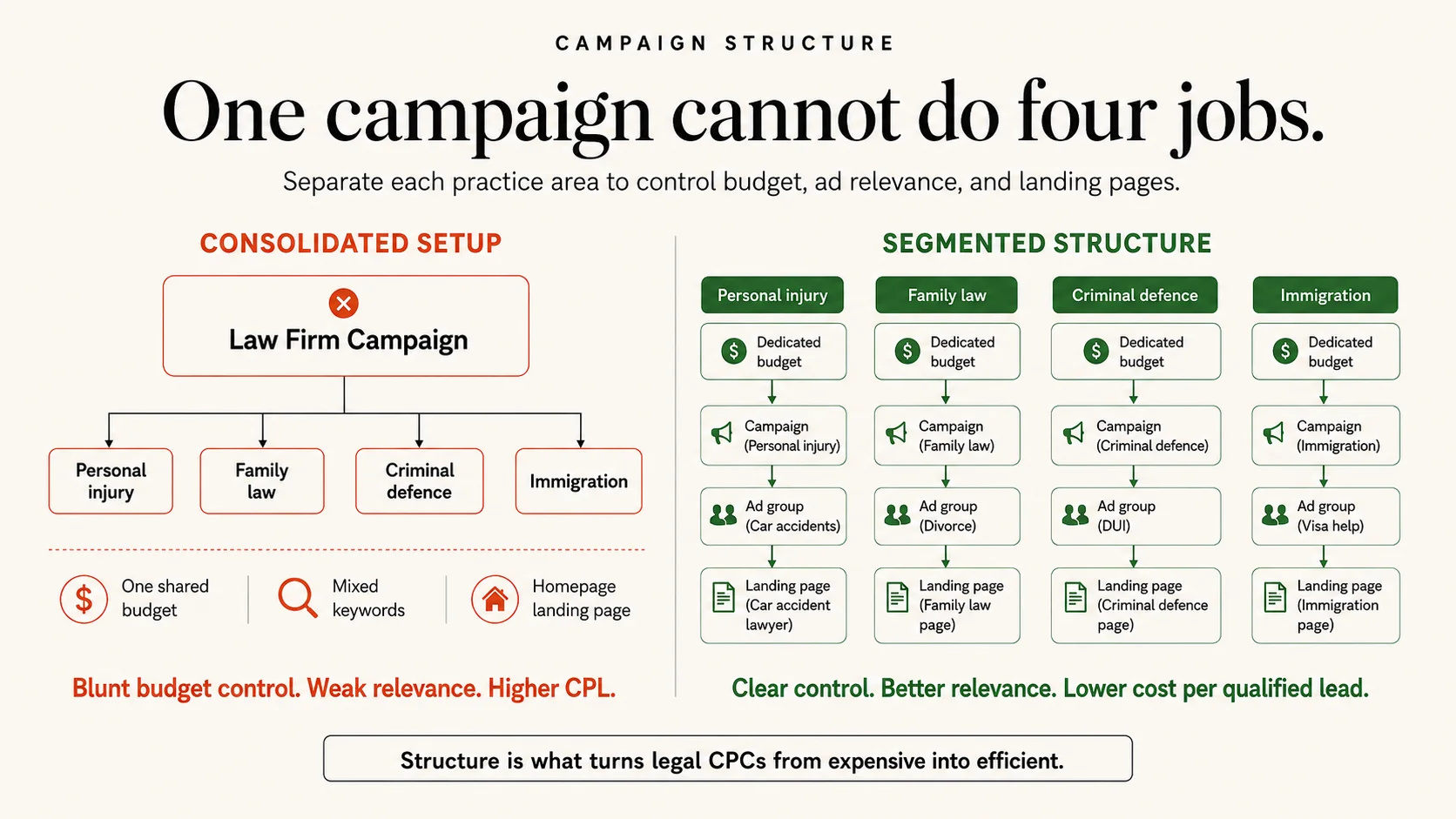
The most important structural decision in a legal Google Ads account is also the simplest one: separate campaigns for each practice area. Personal injury, family law, criminal defence, and immigration are different businesses in terms of search behaviour, CPC, lead quality, conversion rate, and the profile of the person searching. Running them in the same campaign means the algorithm can't optimise for each independently, budget allocation is blunt, and reporting is useless.
Each practice area campaign should have its own:
Ad groups by specific service or case type. Personal injury doesn't belong in one ad group — car accidents, slip and fall, medical negligence, and workplace injuries each have distinct search patterns and deserve distinct ad copy. The tighter the ad group, the more relevant the ad, and the higher the Quality Score — which directly reduces CPC.
Dedicated landing page. Someone clicking a car accident lawyer ad should land on a page about car accident representation, not a general personal injury page and certainly not a homepage. Relevance between keyword, ad, and landing page is the single biggest driver of conversion rate in legal.
Separate budget. Mixing practice areas in one budget means a surge in personal injury CPCs can starve a family law campaign that's performing well. Independent budgets give you control and visibility.
Keywords: Intent First, Everything Else Second
Legal keyword strategy has one governing principle: every pound of budget should reach someone who is actively looking to hire, not someone who is researching whether they need a lawyer. This sounds obvious. Most accounts don't reflect it.
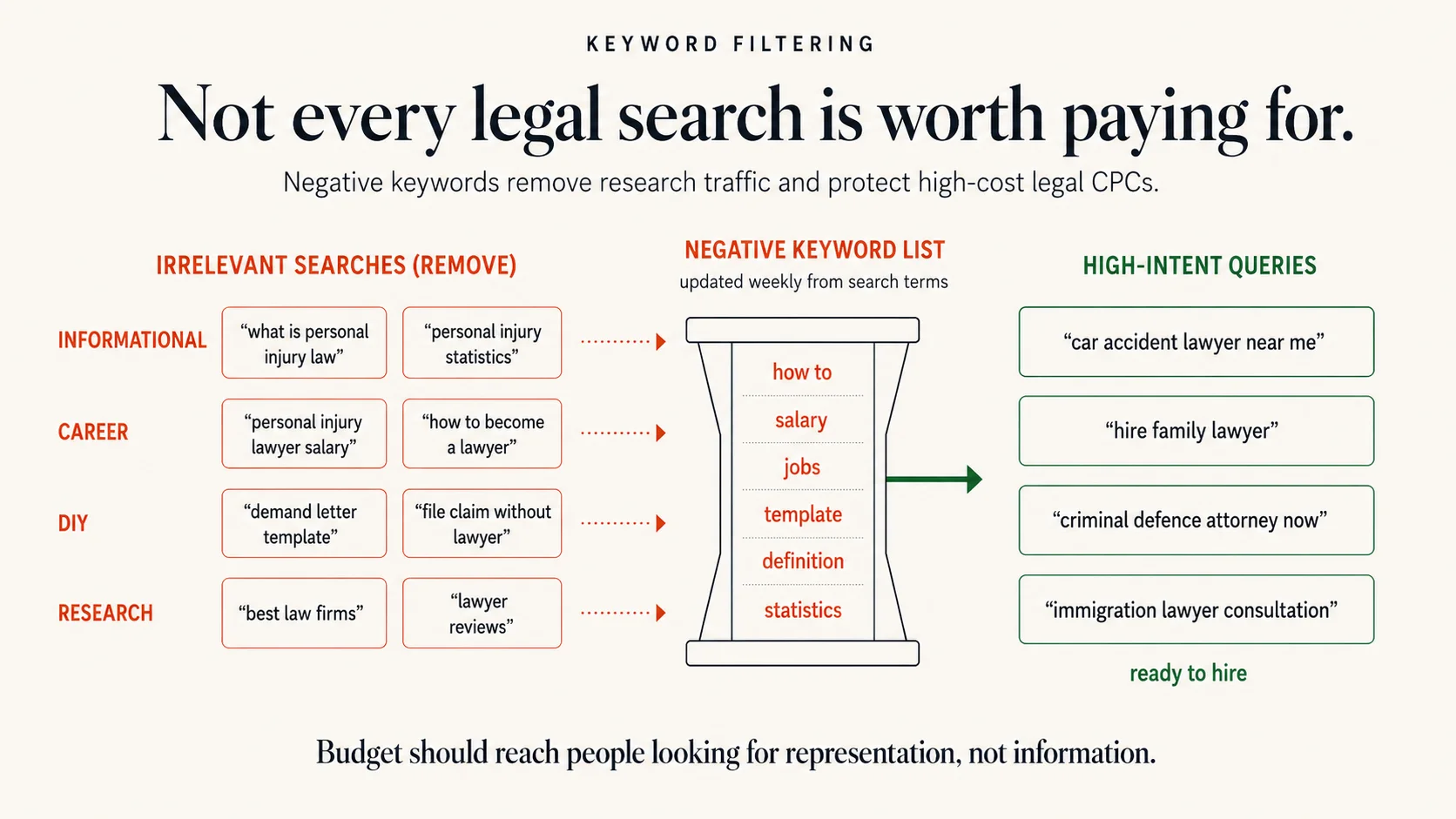
Broad match keywords in legal pull in enormous amounts of irrelevant traffic. A broad match keyword for "personal injury lawyer" will trigger ads for searches like "personal injury lawyer salary," "how to become a personal injury lawyer," "what does a personal injury lawyer do," and "personal injury lawsuit statistics." These clicks cost as much as the high-intent clicks — and they convert at near zero. The fix is ruthless match type discipline: phrase and exact match for conversion campaigns, and a negative keyword list that grows continuously from actual search term data.
Negative keywords in legal deserve more attention than most firms give them. A basic negative list should include: informational modifiers (how to, what is, definition, meaning, average, statistics), career-related terms (salary, jobs, become a, degree, school), DIY-intent terms (do it yourself, without a lawyer, template, form), and any specific firm names or locations outside your service area. This list isn't built once — it's updated weekly from the search terms report, which shows exactly what searches are triggering your ads and wasting your budget.
Competitor keywords deserve a specific decision rather than a default. Bidding on competitor firm names produces clicks from people who already have a preference — conversion rates are typically low, and the ethical and brand considerations are real. It's rarely the best use of legal CPCs.
Conversion Tracking: The Part That Makes Everything Else Work
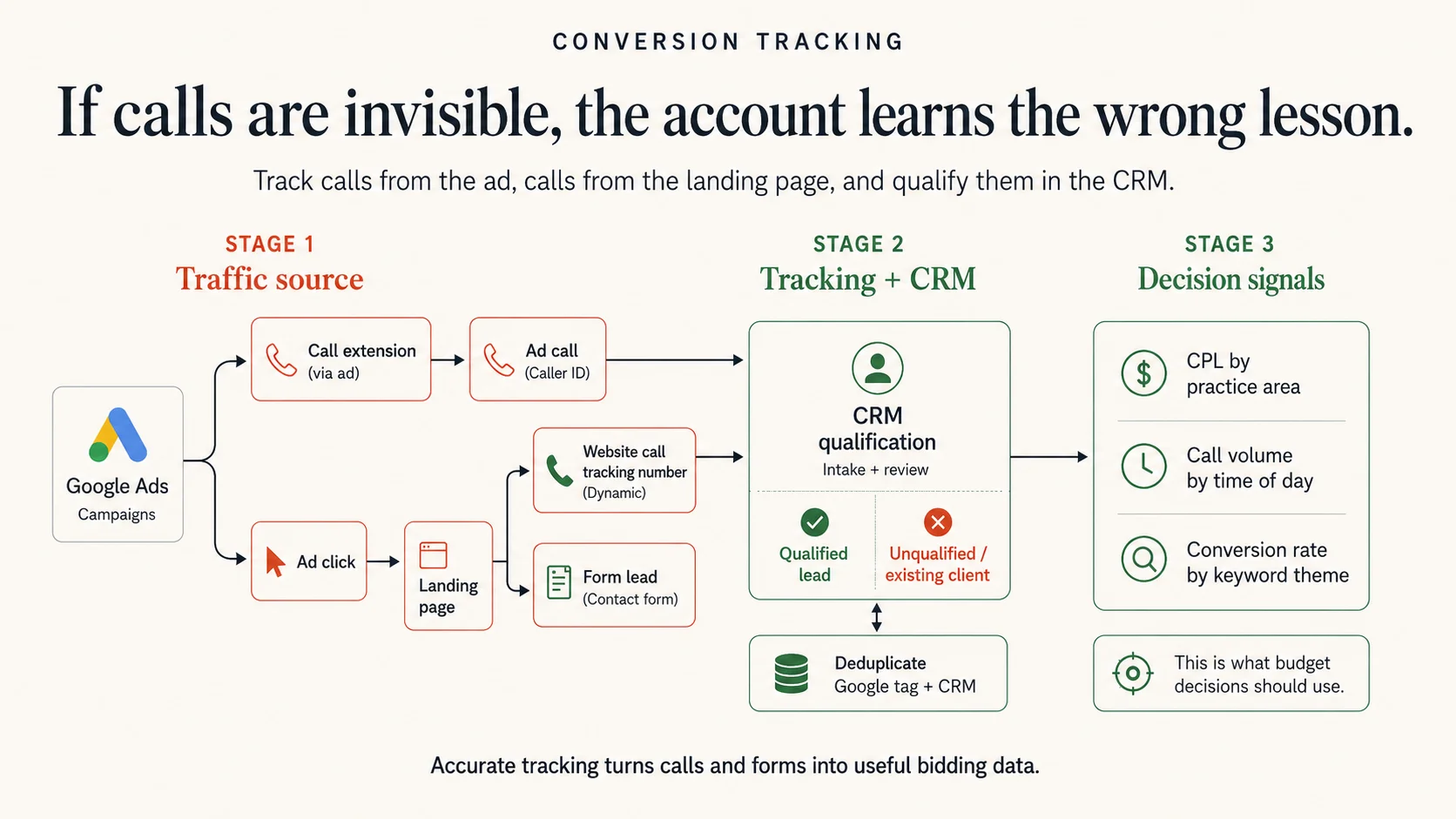
A law firm Google Ads account without proper call tracking is making budget decisions based on incomplete information. Legal leads call — it's the nature of the service. Someone searching for an emergency criminal defence lawyer at 9pm is not filling out a contact form. They're calling. If that call isn't tracked back to the campaign that generated it, the campaign looks like it produced zero conversions, budget gets shifted away from it, and the firm wonders why lead volume drops.
Call tracking for legal requires two things working together: a platform-level call extension that logs calls from the ad itself, and a website-level call tracking number that logs calls from people who clicked through to the landing page. Both need to be set up separately, and both need to fire as conversion events in Google Ads.
Beyond call tracking, legal accounts commonly have two conversion tracking problems. The first is counting form submissions from existing clients or unqualified contacts as conversions — inflating conversion numbers and giving the algorithm bad learning signals. The second is double-counting, where both the Google tag and a CRM integration log the same lead. The fix to both is a CRM integration that distinguishes between qualified and unqualified leads, and a clear deduplication rule between platform and CRM data.
Once tracking is accurate, the data it generates changes how every other decision in the account gets made. CPL by practice area, conversion rate by keyword theme, call volume by time of day — these become the basis for budget allocation, bid adjustments, and ad scheduling. Without accurate tracking, these decisions are guesses.
Bidding Strategy and Budget Reality
The bidding strategy question in legal follows a clear sequence that most firms skip. The default — Maximise Clicks — is appropriate for exactly one period: the early weeks of a new campaign when there isn't enough conversion data for the algorithm to learn from. Once there are 30 or more conversions in a 30-day window, switching to Target CPA changes what the algorithm is optimising for. Instead of finding the cheapest clicks, it starts finding clicks that resemble previous conversions. CPCs increase. Click volume drops. Conversion rate goes up. The business result improves even when the dashboard looks less impressive.
On budget: there is a floor below which legal Google Ads cannot work in competitive markets. In major cities, a personal injury campaign needs enough budget to generate sufficient volume for the algorithm to learn — typically a minimum of $2,000–$3,000 per month per practice area to get meaningful data within a reasonable timeframe. Below that, the account is perpetually in learning mode, the bidding strategy can't optimise, and results are inconsistent. This isn't an argument for spending more — it's an argument for concentrating budget on one practice area until it's working, rather than spreading it thinly across four at once.
A Properly Built Account Isn't More Expensive to Run
The counterintuitive result of building a legal Google Ads account correctly is that it typically costs less per qualified lead than a badly structured account with the same budget. Tighter ad groups improve Quality Scores and lower CPCs. Dedicated landing pages improve conversion rates. Accurate call tracking reveals which campaigns are actually producing cases. Better bidding strategy concentrates spend on high-intent traffic.
None of this requires a larger budget. It requires architecture — the kind of deliberate setup that most firms never get because they either run ads themselves without the time to do it properly, or they work with agencies whose incentive is managing spend rather than reducing cost per case. The firms that get consistent, predictable results from paid search are the ones that treat their account as a system to be built and maintained, not a budget to be switched on.