
Marketing


Vsevolod Hryhorenko
CMO & Co-founder
Three Dashboards, Three Different Revenue Numbers
You open Meta Ads Manager and see $42,000 in attributed purchase value. Google Ads reports another $28,000. GA4 shows a different number again, while Shopify says your store generated $63,000 in actual revenue.
For an ecommerce business owner or marketer, this can immediately look like a tracking problem. If all platforms are measuring the same purchases, why don't the numbers match?
In many cases, nothing is broken. Meta Ads, Google Ads, GA4 and your ecommerce backend simply have different jobs. Shopify records the transactions that actually happened. Advertising platforms try to determine whether their ads contributed to those transactions. GA4 looks at the customer journey across multiple traffic sources and applies its own attribution rules.
This distinction matters because marketing attribution is frequently treated as if it were accounting. A number inside Meta Ads Manager may be useful for evaluating your Facebook and Instagram campaigns, but it should not automatically be treated as revenue that exists separately from what Google Ads reports.
Once several paid channels are involved, overlap becomes unavoidable.
One Sale Can Have Several Marketing Touchpoints
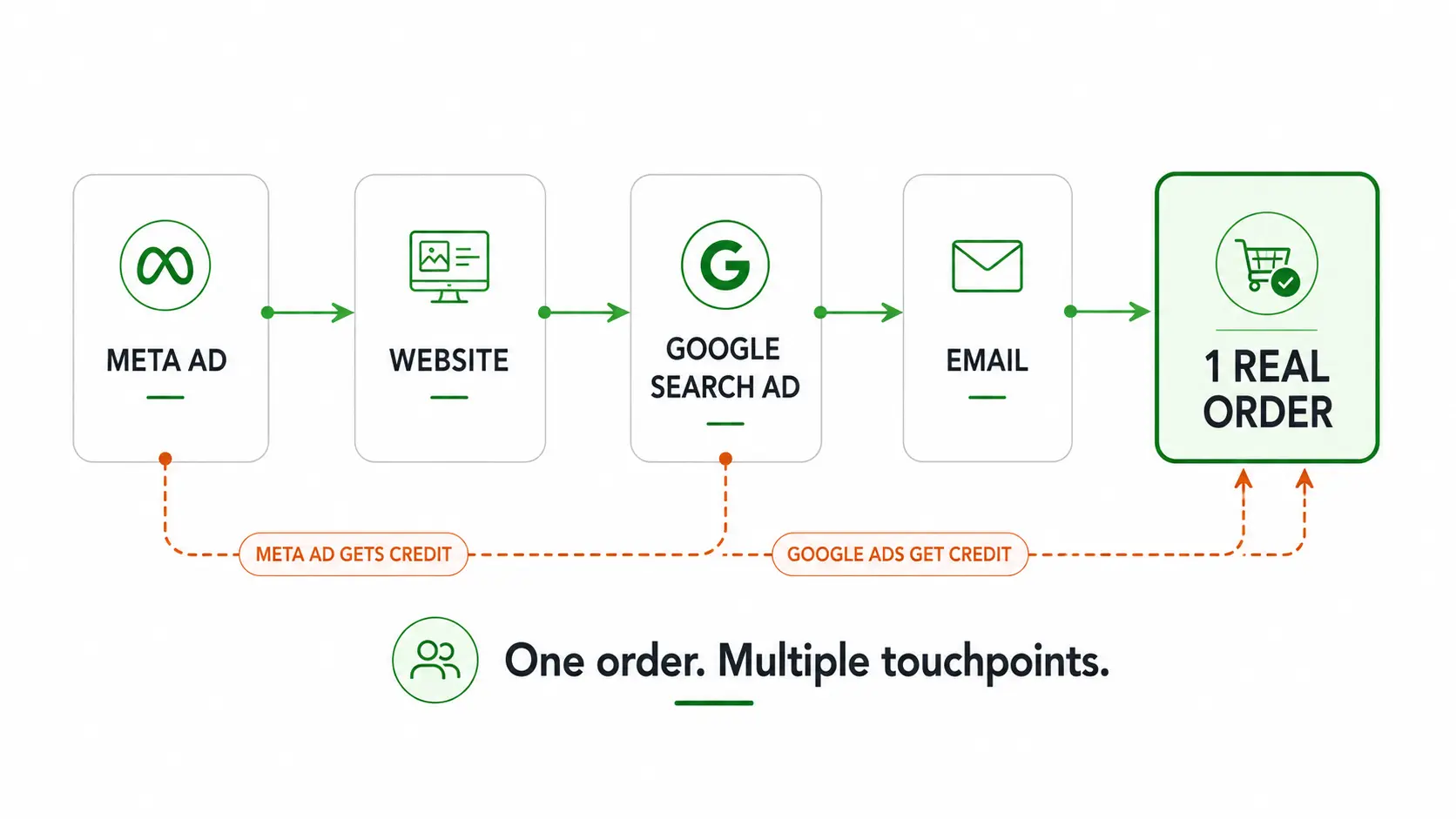
Imagine someone sees your Instagram ad on Monday and visits the website without buying. On Wednesday, they remember the product, search for it on Google and click your Search ad. They still don't purchase. Two days later, an email brings them back and the order is finally completed.
Your store sees one customer and one transaction.
The marketing journey looks more like this:
Instagram ad → Website visit → Google Search ad → Email → Purchase
Meta may receive attribution because the customer interacted with a Meta ad before purchasing. Google Ads may also associate the conversion with its ad click. GA4 can see additional parts of the journey and assign conversion credit according to its attribution setup.
This means a $200 purchase can contribute to the reported performance of more than one marketing channel. There is still only one $200 order in your store.
This is particularly important when analyzing ROAS across Meta Ads and Google Ads. If you simply add the revenue reported by both platforms, you can easily calculate more attributed revenue than the business actually generated.
That does not automatically mean either platform is reporting incorrectly. The numbers answer a different question: how much conversion value can this platform associate with advertising interactions that happened before the purchase?
Why Adding Meta and Google Revenue Can Mislead You
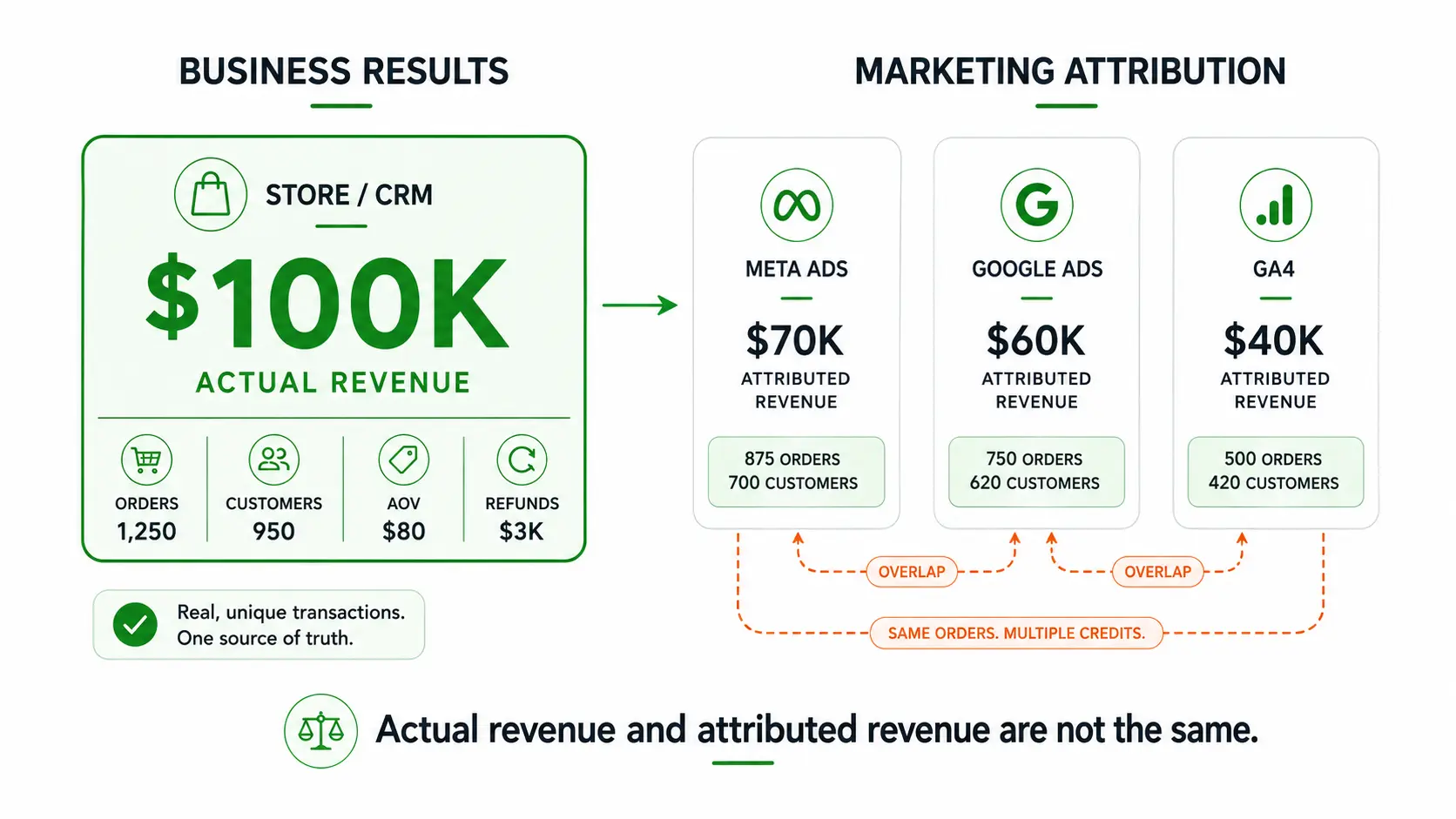
Suppose your ecommerce store generates $100,000 in actual revenue this month. Meta reports $65,000 in attributed purchase value, while Google Ads reports $45,000.
At first glance, you have $110,000 in advertising revenue attached to a business that only generated $100,000.
The explanation can be relatively simple. Your customers might fall into several groups:
customers influenced primarily by Meta Ads;
customers acquired primarily through Google Ads;
customers who interacted with both platforms before purchasing;
customers coming through organic search, email, direct traffic, referrals or other sources.
The third group is where attribution starts overlapping. A customer could discover the brand through Instagram, later Google the product name and eventually buy after clicking a Google Search ad. The same transaction now contains useful signals for both advertising platforms.
Real customer journeys are also becoming harder to reduce to a single acquisition source. Someone might watch three Reels, visit your website twice, read reviews, search for the brand on Google and return through a retargeting campaign before purchasing.
Forcing the entire value of that customer into one channel gives you a cleaner spreadsheet, but not necessarily a better understanding of what influenced the purchase.
GA4 can provide additional context because it analyzes traffic across several channels. It can help you see how paid social, paid search, organic traffic, email and direct visits interact. Still, GA4 depends on the data it can observe and the attribution model being used, so its revenue numbers should also be interpreted rather than accepted without context.

Your Ecommerce Backend Has a Different Job
When you need to answer a basic financial question such as "How much revenue did we actually generate?", your store backend, payment processor or CRM should be the primary reference.
If Shopify records $100,000 in sales, Meta cannot create another $65,000 on top of it. Google Ads cannot create another $45,000 either. Their reported conversion values exist inside attribution systems and help you understand marketing performance.
For most ecommerce businesses, it helps to separate reporting into two broad areas:
Business performance
actual revenue;
orders;
new customers;
refunds;
average order value;
gross margin;
customer acquisition cost;
repeat purchases.
Marketing attribution
attributed conversions;
attributed revenue;
platform ROAS;
channel contribution;
conversion paths;
campaign and creative performance.
Your store data also has limitations. Imagine somebody discovers your company through an Instagram ad, visits the website and leaves. Four days later they type your domain directly into their browser and purchase.
The final visit may appear as direct traffic in analytics, but saying that marketing had no influence on the purchase would ignore everything that happened before it.
This is why strong marketing reporting usually combines backend data with attribution instead of choosing one and ignoring the other. The backend establishes the actual commercial result, while attribution provides evidence about which channels, campaigns and touchpoints contributed to getting the customer there.
What You Should Actually Use Each Platform For
A useful reporting system does not require every dashboard to agree. It requires you to know which dashboard should answer each question.
Store, payment processor or CRM
Start here when evaluating the health of the business. Track actual sales, order volume, customer acquisition, refunds, repeat purchases and profitability. For an ecommerce brand, these numbers ultimately determine whether paid advertising is creating sustainable growth.
Meta Ads Manager
Use Meta's data primarily to make decisions inside the Meta ecosystem.
For example:
Which creative generates more purchases?
Which campaign deserves additional budget?
Is prospecting outperforming retargeting?
Which offer produces a stronger conversion rate?
Is performance improving or declining over time?
The reported Meta ROAS does not need to match Shopify perfectly for these comparisons to provide useful information.
Google Ads
Google Ads reporting should help you understand how your Search, Shopping and other Google campaigns perform relative to each other.
Look at conversion value alongside search intent, campaign structure, conversion rate, cost per acquisition and actual business quality. For lead generation businesses, the cheapest conversion can easily produce the worst customers, which is why CRM feedback becomes especially important.
GA4
GA4 becomes useful when you want a broader view of acquisition.
Instead of looking only at what happened inside Meta or Google, you can analyze how channels interact throughout the customer journey. It can reveal situations where paid social frequently introduces customers while search captures them later in the buying process.
Before comparing any platforms, make sure the basics are aligned. Check the date range, timezone, conversion event, attribution settings and revenue definition. Otherwise, you may spend hours investigating an attribution issue that is actually just a reporting configuration problem.
Better Attribution Should Lead to Better Decisions
The purpose of marketing analytics is not to make Meta Ads, Google Ads, GA4 and Shopify display an identical revenue number.
What matters is whether you can use the available data to make better decisions about your advertising budget.
Start with business performance. Look at how much you spent, how much revenue the company actually generated, how many new customers were acquired and whether the economics still make sense after product costs, agency fees, discounts, shipping and other expenses.
Then move into attribution. Look for evidence that helps explain the business result. If Meta performance improves at the same time new customer acquisition and total store revenue grow, that matters. If Google Ads reports fantastic ROAS while overall revenue stays flat and branded search captures customers who were already looking for you, that deserves a closer look.
No individual metric should make the decision for you.
For most ecommerce brands, the most useful questions are broader:
Is total revenue growing?
Are we acquiring more new customers?
What does it cost to acquire them?
Are contribution margins healthy?
Which channels appear to create new demand?
Which channels capture existing demand?
What happens when we increase or reduce spend?
Are those customers coming back and buying again?
The answers will rarely come from a single dashboard.
Good attribution gives you enough context to understand how paid advertising contributes to the business. Good marketing decisions come from combining that context with the numbers that ultimately matter: customers, revenue and profit.