
Facebook Ads


Mykyta Hryhorenko
CEO & Co-founder
The Problem Every Growing Brand Hits
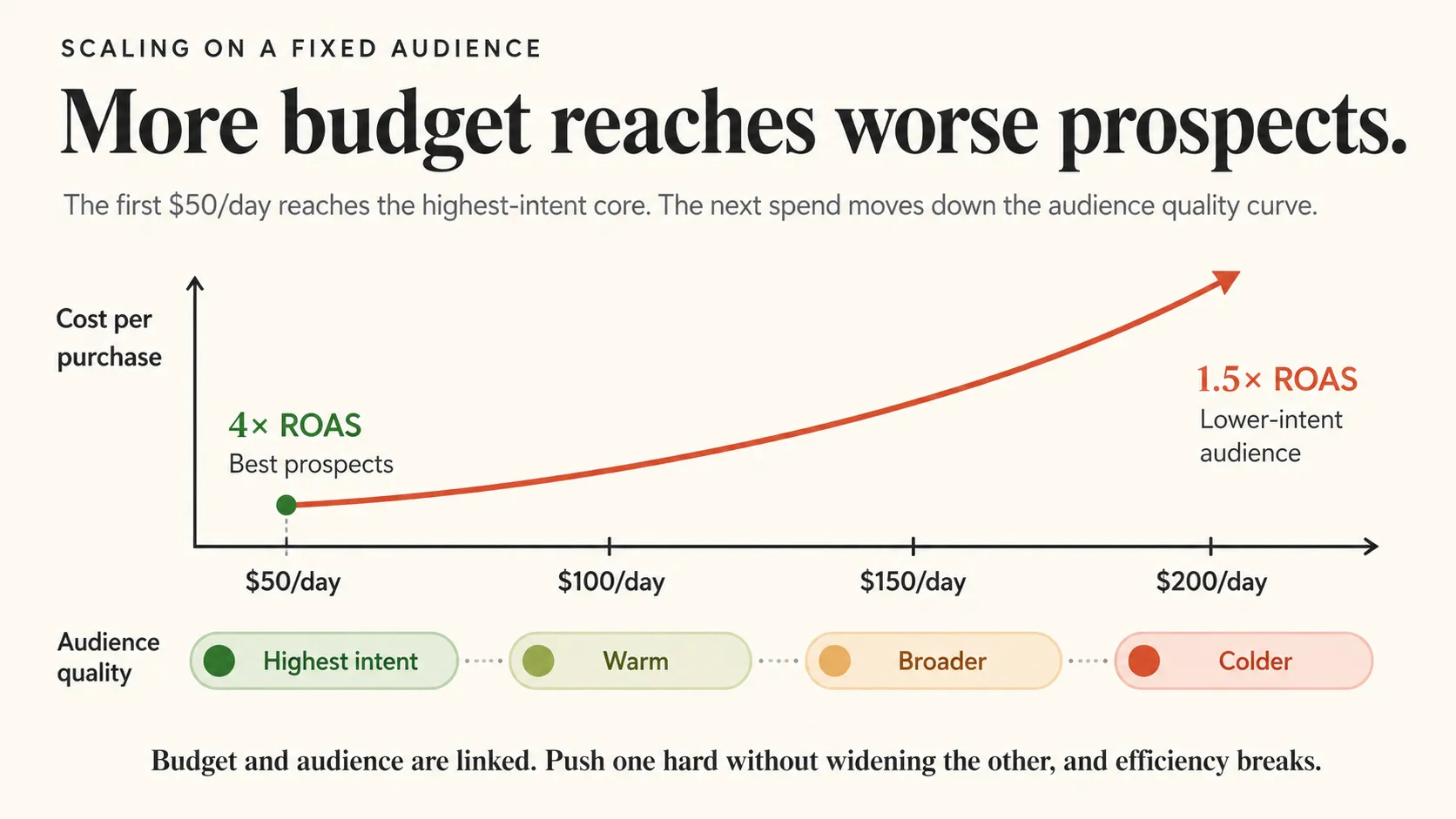
$50 a day. A 4× ROAS. Profitable, predictable, boring in the best way. So you do the obvious thing and push it to $200 — and the engine that was humming starts grinding. ROAS drops to 1.5×, cost per purchase doubles, and a campaign that printed money last week is now losing it.
The easy conclusion is that you've hit a ceiling — the product, the market, the audience just won't go further. Sometimes that's real. Much more often, the ceiling isn't the market. It's the method. Facebook's auction and learning systems react to how you scale at least as much as to how much — and the default move, "find a winner and crank the budget," is almost perfectly engineered to break the winner.
Why More Budget Breaks a Winning Campaign
Raising a budget isn't "the same ad, more people." Two things happen under the hood, and both work against you.
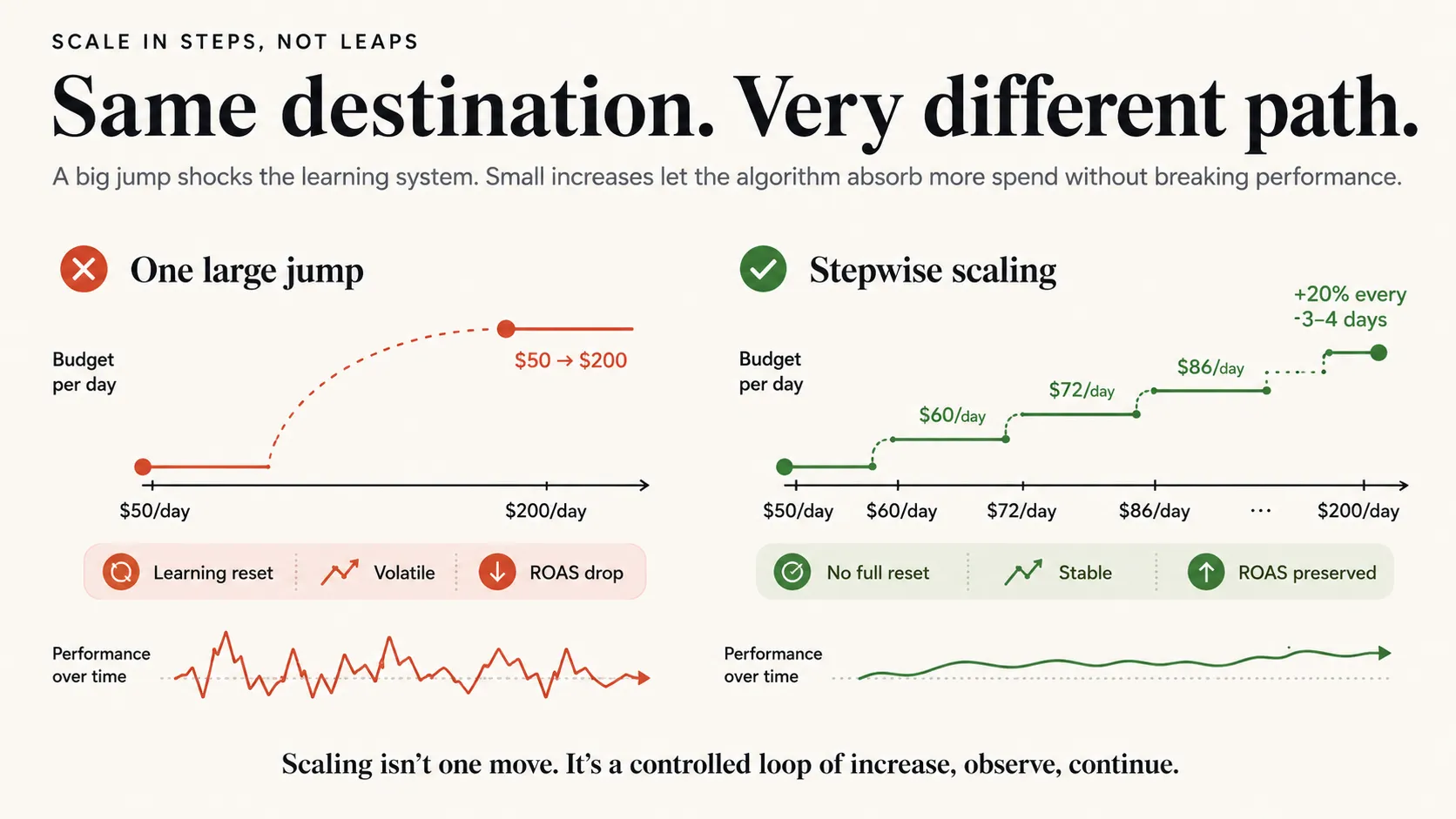
The learning phase resets. Every ad set starts in a learning phase — the algorithm collecting conversion data, figuring out who to target. Performance during it is volatile and usually worse than what follows. A campaign that's been running smoothly has exited learning; it's settled. A big budget change throws it back in — and now the volatility plays out at a higher daily spend, so the instability costs more than it did the first time.
The audience quality curve bends down. Ask Facebook to spend 4× more on the same audience and it has to find 4× more conversions. To get them, it moves past the high-intent core that was converting cheaply and into broader, colder segments.
The first $50 reached your best prospects. The next $150 reaches progressively worse ones.
Average cost per purchase climbs, ROAS slides, and the dashboard reads like the campaign suddenly stopped working — when really it's just reaching the people it used to be smart enough to skip.
The lesson underneath both mechanisms: budget and audience are linked. Move one hard without addressing the other and performance breaks, every time.
Scale in Steps, Not Leaps
The most effective scaling principle is also the most ignored, because it's slower than anyone wants: raise budgets gently enough that you never reset learning. The working rule most experienced buyers settle on — about +20% every 3–4 days.
Here's why that specific restraint works. A 20% bump is small enough for the algorithm to absorb without a full learning reset, so performance holds while spend rises. Watch the same destination reached two ways:
The leap: $50 → $200 in one move. A 300% jump, a guaranteed learning reset, volatility at every stage.
The steps: $50 → $60 → $72 → $86 → … Same endpoint, no reset, ROAS intact the whole way up.
Patience here isn't caution for its own sake — it's the actual mechanism that keeps a campaign profitable while it grows. And it means scaling is never a thing you do once and walk away from. It's a loop: nudge the budget, watch whether performance holds, continue or pause on the evidence. Brands that scale well run it as a steady discipline, not a single bold decision.
Horizontal Beats Vertical
Two directions to scale. Most brands reach for the weaker one by instinct.
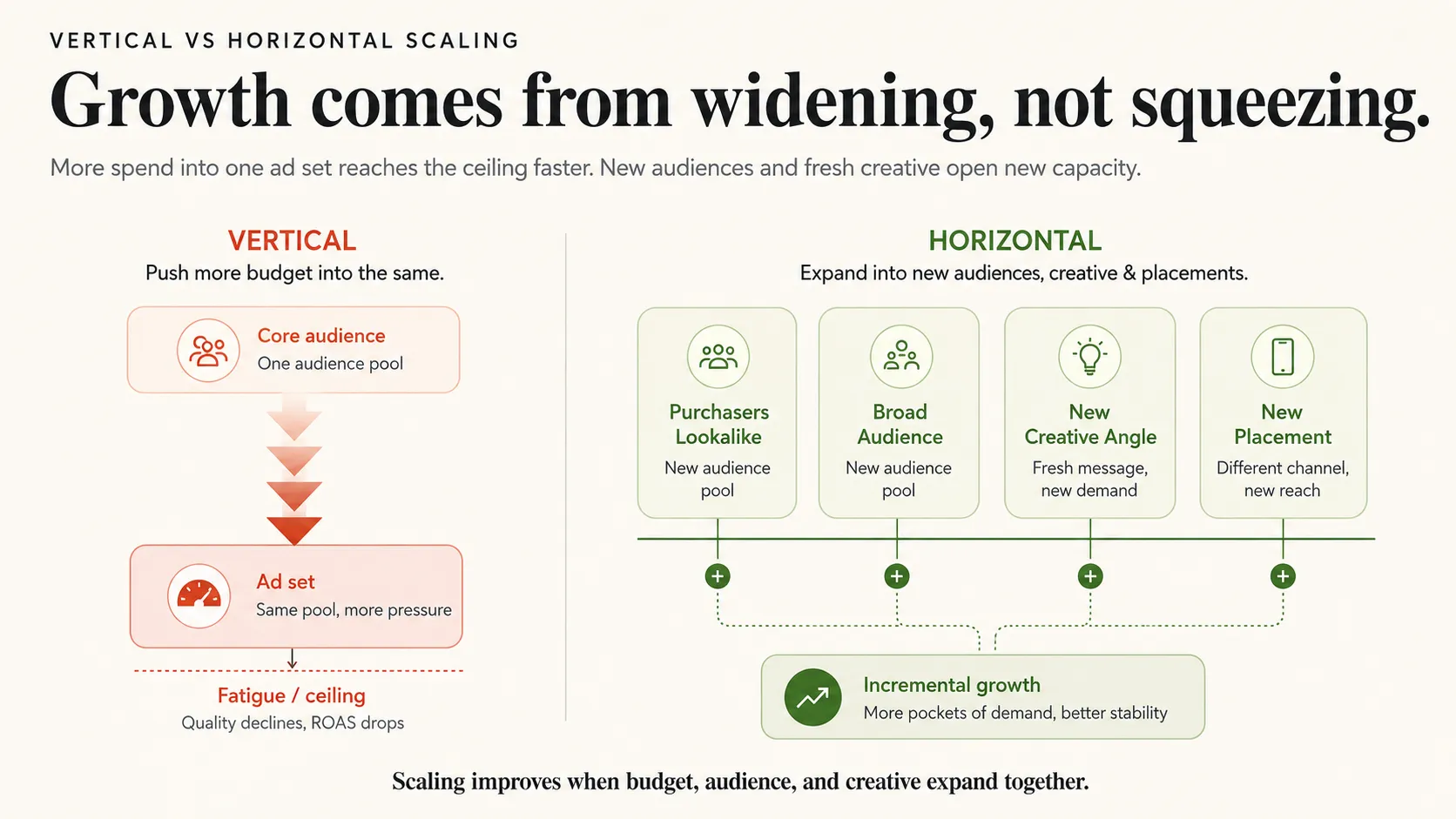
Vertical — more budget into existing ad sets. Useful, but it slams straight into the audience-quality ceiling, because you're demanding ever more conversions from the same pool. Horizontal — expanding outward into new ad sets, audiences, and creative angles, each opening a fresh pool instead of squeezing an exhausted one.
Horizontal wins because it respects how audiences actually behave. In practice:
New lookalike audiences. Instead of pushing one 1% lookalike harder, build more from different sources — purchasers, high-value customers, engaged visitors — each surfacing people the original left out.
New creative for the same audience. Fatigue is a real ceiling: the same ad seen too often converts worse over time. A fresh angle re-engages people the old ad wore out — new capacity inside an audience you'd already reached.
Broad targeting alongside lookalikes. As conversion data grows, broad targeting often scales better than tight audiences, because the algorithm finally has enough signal to find buyers on its own.
New placements and formats. Reels, Stories, formats you haven't touched — the same people, new contexts, demand the original setup never tapped.
One principle ties them together: growth comes from widening the funnel, not forcing more volume through a width that's already maxed out.
Creative Is the Real Scaling Constraint
Past a certain point, the thing capping an account isn't budget, audience, or bidding. It's the rate at which a brand can produce creative that works. Most brands underestimate this — and it's usually the real reason growth stalls.
The mechanism is fatigue, and spend level changes its speed. Every ad has a finite lifespan: it performs, the audience sees it on repeat, engagement and conversions decay, cost per result climbs. At low spend that decay is slow — the budget reaches people gradually. At high spend it's fast: a bigger budget burns through an audience's attention far quicker.
A winning ad that lasted two months at $50/day might fatigue in two weeks at $300/day.
So the brands that scale aren't the ones with a single brilliant ad — they're the ones with a pipeline producing new concepts faster than the old ones wear out. Which reframes the whole problem: scaling is a production challenge more than a media-buying one. A reliable stream of fresh, tested creative can feed a growing budget indefinitely. One or two winners can't — and no amount of bidding optimisation fixes a creative supply problem. The constraint was never how much you can spend. It's how much you can make.
Scaling Is a System, Not a Switch
Scaling without wrecking ROAS comes down to working with the platform's mechanics instead of against them: raise budgets gradually enough to protect the learning phase, expand horizontally into new audiences and angles instead of only pushing existing ones harder, and run a creative pipeline fast enough to stay ahead of fatigue. None of it needs a bigger budget than the brand already has. It needs a different method.
Brands that plateau treat scaling as a switch — find a winner, flip the spend, expect the results to multiply. Brands that grow treat it as a system, where budget, audience, and creative move together in a controlled, repeatable way. The ceiling most brands think they've hit isn't the limit of their market. It's the limit of their method — and the method is the one thing fully within their control to change.