
Marketing

Mykyta Hryhorenko
CEO & Co-founder
The Hype Has Outrun the Reality
Every marketing tool now has "AI" stamped on it. Every agency claims to use it. Every business owner has been told it will transform their marketing. Some of that is true. Most of it is positioning — and businesses are making real budget decisions based on the positioning rather than the reality.
Here's the more useful frame. AI isn't good or bad for marketing; it's good at specific things and quietly bad at others. Where it processes volume, finds patterns, or generates variations, it removes hours of work and improves results. Where it replaces judgement — strategy, taste, knowing when something is wrong — it produces output that looks finished, performs poorly, and is hard to diagnose because no one really understood it in the first place. The entire question is matching the tool to the task.
Where AI Genuinely Helps
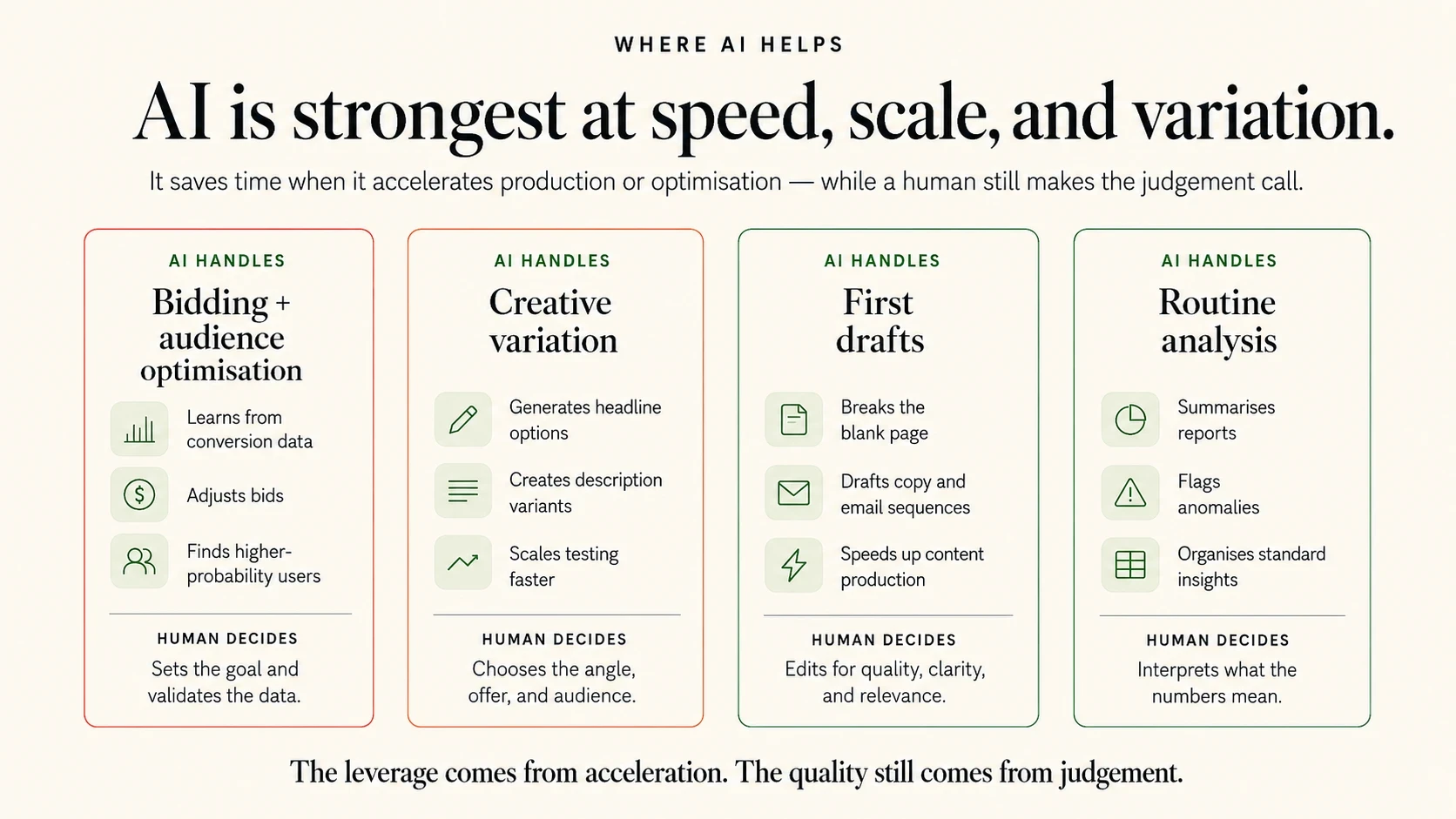
The marketing functions where AI has become genuinely valuable share one trait: they involve processing scale or generating options faster than a human can, while a human still makes the decision that matters.
Bidding and audience optimisation. This is the most valuable and least discussed application. Google's and Meta's machine learning, fed clean conversion data, consistently outperforms manual bidding and audience targeting. It's been running for years — Smart Bidding, Advantage+, Performance Max — long before "AI" became a label. A campaign with 30+ conversions feeding Target CPA will almost always beat one a human is bidding manually. This is AI that works, and most businesses are already using it without calling it AI.
Creative variation at volume. Generating 15 headline variants or 10 description options to test is genuinely faster with AI. The strategic input — the angle, the offer, the audience — stays human. The production of variations to test does not.
First drafts. For copy, email sequences, and content, AI clears the blank-page stage in seconds. The value is acceleration, not finality. A marketer editing a draft moves faster than one starting cold — but the editing is where the quality comes from.
Routine analysis. Summarising performance, flagging anomalies, generating standard reports — AI handles these well, freeing time for the interpretation that actually needs a person.
Where AI Quietly Hurts
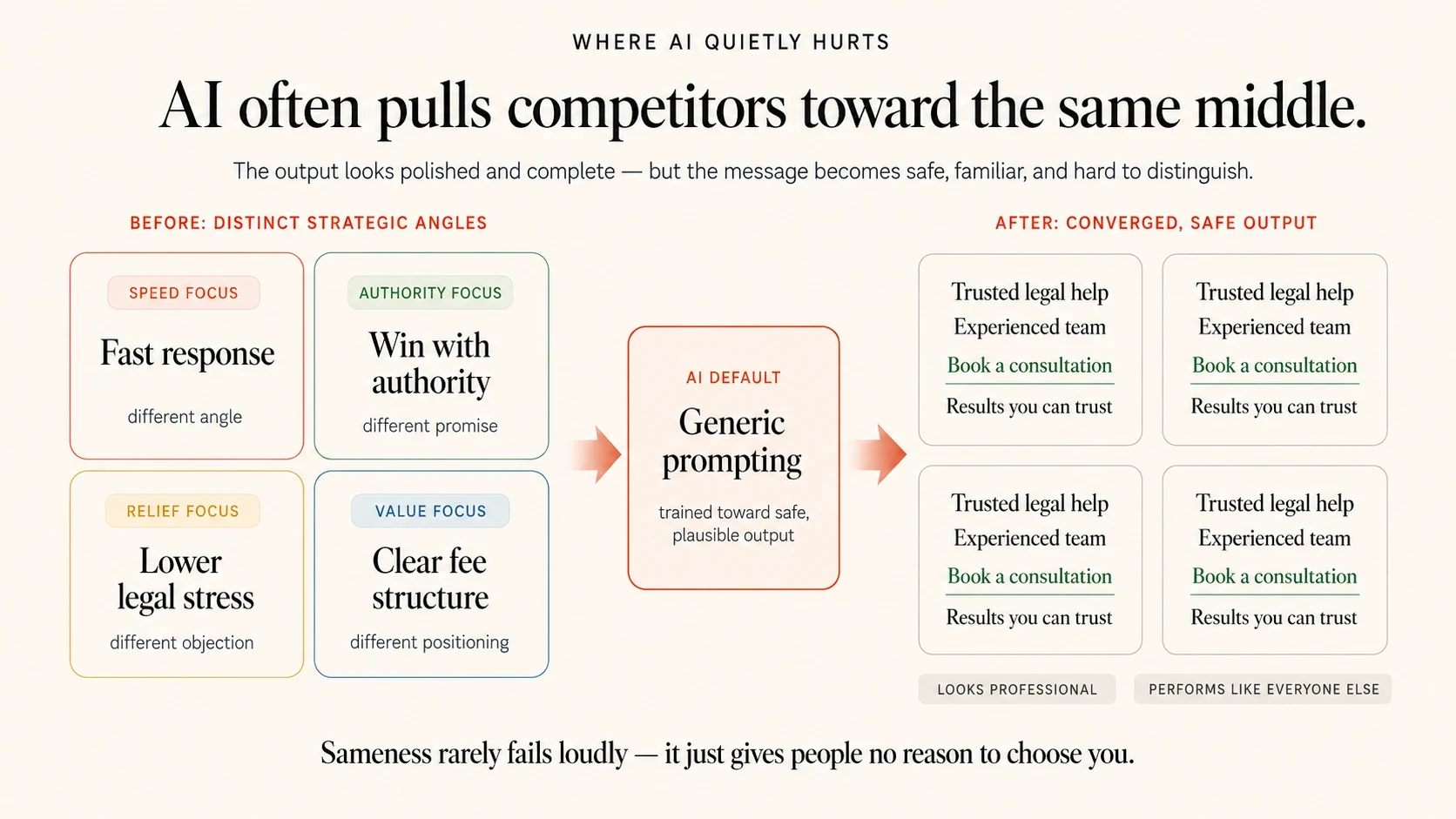
AI's failures in marketing don't announce themselves. The output looks complete, the process feels efficient, and the cost shows up downstream where it's hard to trace.
The most common failure is convergence. AI tools are trained on similar data and pull toward a recognisable middle — competent, inoffensive, undifferentiated. When every business in a category prompts the same tools, the output converges on the same safe message. The brands that stand out increasingly do the opposite of what the tools default to. This doesn't fail loudly; it just underperforms quietly, and because the output looks professional, the blame lands on budget or targeting instead of on the sameness of the message.
The second failure is automation without understanding. AI makes it possible to launch sophisticated-looking campaigns without grasping the mechanics underneath. That holds up until something breaks — conversions drop, CPCs spike, delivery stalls — and the person who deployed it can't diagnose the problem because they were operating the tool, not the strategy. In paid advertising, that gap gets expensive fast.
The third is misplaced trust in AI-reported numbers. Modelled conversions and AI-estimated attribution arrive with a confidence the underlying data doesn't earn. As privacy restrictions cut into direct tracking, platforms fill the gaps with estimates — and those estimates lean optimistic, because the platform reporting them benefits when they do. Treating an estimate as a measurement is how budgets get allocated on numbers that aren't real.
The Skill That Actually Matters Now
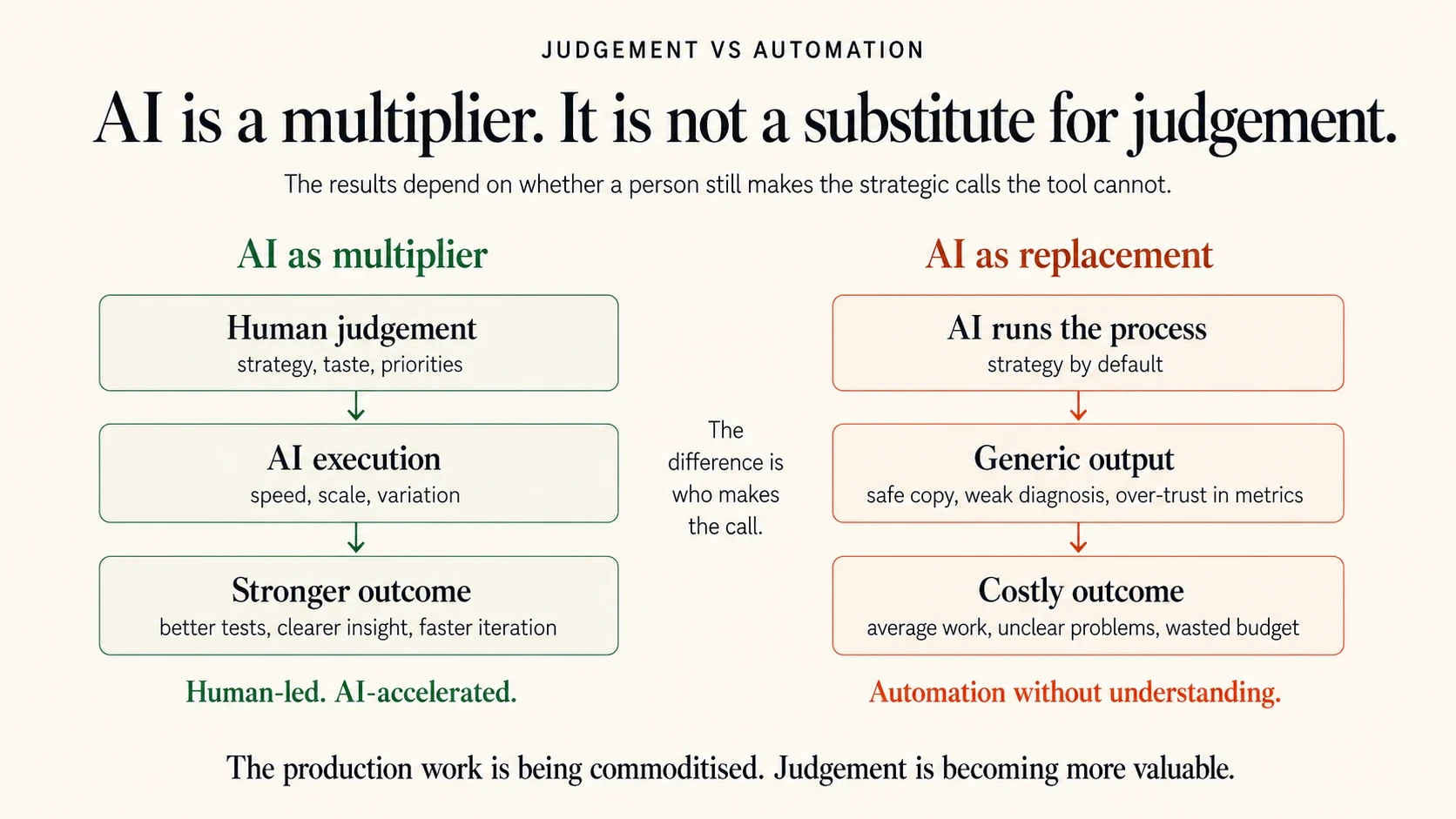
As AI absorbs the production work, human value doesn't vanish — it concentrates into the parts AI can't do: judgement, strategy, taste, and recognising when the output is wrong.
Knowing what to test beats being able to generate tests. Knowing which audience matters beats being able to build audiences. Knowing whether a line of copy hits a customer's actual objection — not just whether it sounds plausible — is the difference between copy that converts and copy that fills space. These are judgement skills, and they're appreciating in value precisely because the production skills around them are being commoditised to near zero.
For a business evaluating a tool or a partner, this reframes the question entirely. "Do you use AI" is meaningless — everyone does. The real questions are sharper: can you explain what the AI is optimising for, what data it learns from, and where it tends to be wrong? Who makes the calls the AI can't? A tool that claims to run everything end to end isn't offering a feature; it's removing the judgement that makes the difference. AI directed by someone who understands it is a multiplier. AI substituting for that understanding is a slow, costly mistake.
How to Tell Real AI Value From Marketing Spin
Because every tool and agency now claims AI capability, the practical skill is separating substance from spin. A few questions do most of the work.
Ask what the AI specifically does, and whether someone can explain the mechanics. Genuine capability comes with a clear account of what the tool optimises for and where it fails. A vague answer — "it uses AI to optimise your campaigns" — usually means standard platform automation that every account already has, repackaged as a differentiator.
Then ask who makes the decisions the AI can't. If the answer is that the tool handles everything unsupervised, that's the warning sign, not the selling point. Accounts that perform have a person making the strategic calls and using AI to execute them faster. The value was never in the automation — it's in the judgement steering it.
The Tools Changed. The Fundamentals Didn't.
For all the disruption, the fundamentals still hold, and AI hasn't touched them. You still need to understand your customer, lead with a clear offer, speak to a real objection, and measure accurately enough to know what's working. AI accelerates the execution of every one of these — but it decides none of them, and businesses that hand those decisions to the tools get average results, because average is exactly what the tools are built to produce.
The businesses winning with AI use it to do more of what they already understand, faster. The ones losing with it use it to avoid understanding their marketing at all. The technology is an amplifier. What it amplifies is whatever judgement — or absence of it — is pointing the tools.